Nélida Nassar 11.03.2026
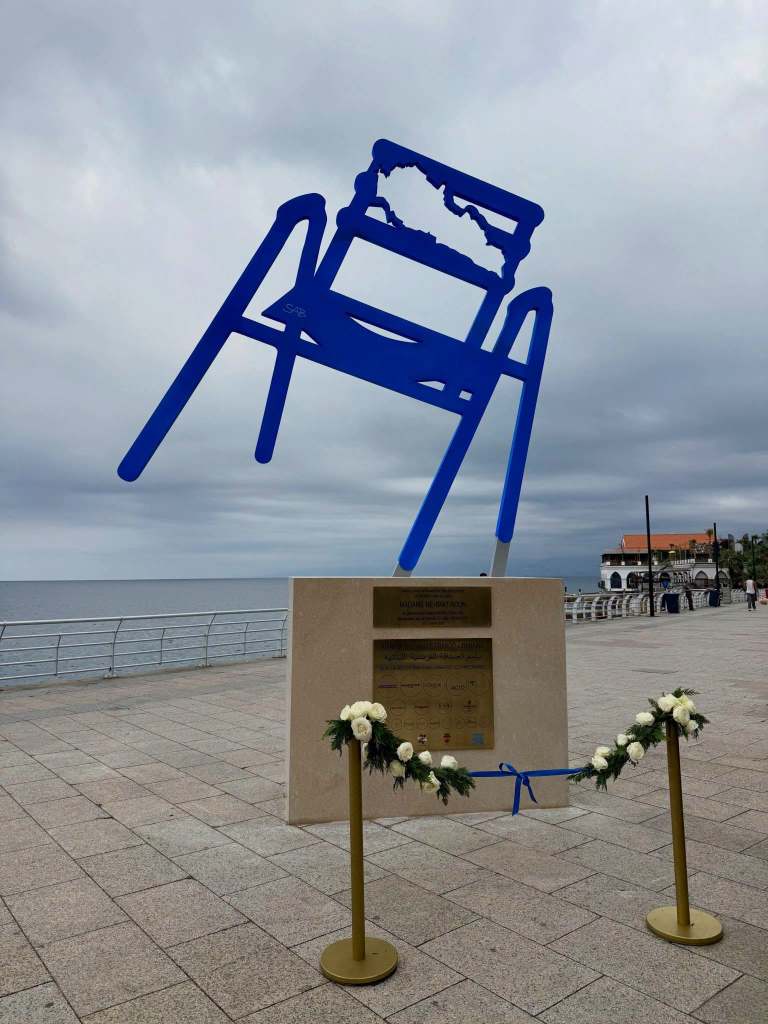
For the last week Lebanon has been rocked by news about the installation of SAB’s Blue Chair by French artist Sabine Géraudie (known as SAB), in the area of Ain el-Mreisseh in Beirut. Why is SAB’s incongruous Blue Chair, standing on one leg, getting so much attention and provoking such controversy? The Lebanese public is quite naturally asking what all the fuss is about.
Though I am in agreement with my compatriots’ strong reactions, I should make clear that I recognize that we are talking about a work of art, and I am aware that art contains so much more than what first meets our eyes. It has the potential to open a whole new world before us! And I know that it always has to do with people. About women and men who in one way or another have wanted to tell us something, through a language of colors, lines, forms and shapes.
That said, what about this particular work? The original blue chair was created in France in 1948 by Charles Tordo and then modernized by the prominent architect Jean-Michel Wilmotte in 1996 before being reappropriated and reimagined as a monumental pop art sculpture by Sabine Géraudie. Presiding over the Promenade des Anglais, it became an iconic tribute embraced by the city of Nice as an extension of its own memory and maritime identity. It represents the type of chair used for decades along the city’s famous beaches.
A friendship that developed between Géraudie and a Lebanese fundraiser residing in Nice led to a restricted public presentation over 7 years ago at Casino du Liban to a group of friends and acquaintances who thought it was a suitable design concept for Beirut. Last week, the SAB’s Blue Chair was installed with great official fanfare under the auspices of the country’s First Lady and many officials and ministers. It was financed by several benefactors in the name of Franco-Lebanese cultural exchange and cooperation.
Despite the project’s apparently good intentions, one cannot refrain from asking what the rationale is for bringing this chair to Lebanon, where it has become an eyesore for many residents. In my view, the sculpture is a pastiche which offends history, semantics, semiotics, art, public space, philosophy and beauty as well as common sense.
1. Defiance of History: The chair is admittedly appropriate for the city of Nice and its history, but is transposing it to Beirut because it is another friendly Mediterranean city a sufficient reason to do so? Does Beirut, a millennia-old city with numerous meaningful monuments expressive of its heritage, need history lessons and interventions from a foreign country?
2. Defiance of Cross-Cultural Semantics: Different languages and cultures shape and divide up meaning in unique ways. Does this chair create a meaningful cultural dialogue between the two cities?
3. Defiance of Semiotics: Does this chair possess any specific significance for Beirut, and does this object communicate any idea beyond its literal form – despite the supposed justification of having a cut-out map of Lebanon on its back? Did a committee assess its relevance and visual impact?
4. Defiance of Genius Loci: The Corniche is not a blank canvas for private sponsors and political endorsements. It is a shared public space whose identity and character deserve protection by the municipality and the national government. Sponsorship does not grant anyone the right to reshape our city. At no time did the project go through a planning process or any other independent review. There was no public consultation of any type. The sponsors are not the owners of the public space.
5. Defiance of Art: I am not interested in dissecting in depth – if any depth exists – the “hidden motives” at play in Géraudie’s work. Suffice it to say that she clearly is inspired by American artist Jeff Koons, who often uses ordinary everyday objects in his art. She also attempts – to give her more credit – to carry on a tradition first established by French artist Marcel Duchamp in the early twentieth century. Often referred to as the father of conceptual art, he chose objects including a bottle rack, a shovel and a urinal and called them ready-made artworks, describing his selection of these objects as a creative act. By ignoring the object’s ‘useful’ function and presenting it as an artwork, like Duchamp, Géraudie thought that she would give her chair a new meaning. And that by taking a mass-produced, everyday object associated with domestic, outdoor life and presenting it as art, she could raise its status from the ordinary to the iconic. However, her sculpture fails to explore the way fantasies and desires can be transferred to an everyday object.
The SAB’s Blue Chair is simply literal, lacking the critical, skeptical, and intellectual depth of Duchamp’s original ready-mades. She strips the readymade of its subversive charge, transforming it into something monumental, seductive, and, in the end, kitsch. She does not seek to unsettle the viewer or to prompt doubt; rather, she aims to dazzle through technical mastery and surface brilliance, demanding passive acceptance instead of critical reflection.
6. Defiance of Philosophy and Beauty: Moreover, with her chair Géraudie raises no philosophical or aesthetic questions, such as: What defines art? Is it the object itself, or the context surrounding it? Is it an act of intellectual sabotage, tinged with irony and a distrust of institutions? If Duchamp could weigh in on this pseudo-ready-made, he certainly would reject it as a falsified object. As for Koons, he will no doubt have a good laugh, mocking it as a bad example of mimicry.
The Lebanese public appears a little dazed as it dutifully takes out its iPhones and produces its selfies. Still, a great number of artists are incensed by this sculpture, requesting that Lebanon’s government act responsibly when commissioning art. The public had great expectations for the present government. Its hopes were disappointed and now it is demanding an end to the kakistocracy, a government run by the least qualified and most unscrupulous citizens.
Ironically, one can joke that each of the four legs of SAB’s Blue Chair could be dedicated to one of Lebanon’s four centres of power: executive, legislative, judicial, and religious – all four in a precarious equilibrium, playing musical chairs and vying to supplant one another. At present, Lebanon doesn’t need a corporate-backed spectacle. The country is experiencing a multi-layered crisis involving ongoing military friction, internal political tension, and severe economic and humanitarian strains. In view of these numerous problems, this futile “SAB’s Blue Chair” comes across as crude and juvenile, an icon of late capitalism, and a caricature of the art world. It is a reflection that may represent the vacuous nature of most contemporary art, but it also reflects who we are at the moment. The president and his wife, as well as the entire government, are stewards of Lebanon’s land and public space for future generations; they are not owners with a right to encumber it with their names in capital letters on hideous plaques and pedestals.

