Nélida Nassar 06.07.2023
Among the ever-increasing number of musical works emerging from the dustbin of history, the interest of some of them is not immediately apparent to the ears, and, frankly, we sometimes think that they could just as well have remained forgotten. The desire to run with fashion and, snobbery, sometimes tinged with nationalism, seem to have motivated more than one resurrection where significant musical qualities were virtually undetectable. Such dubious ventures have ended up making music lovers wary of even truly meritorious works. You have probably never heard of Henry Desmarest’s 1694 tragédie en musique, Circé, but rest assured, in this case it was well worth the major effort the Boston Early Music Festival (BEMF) has made to exhume it.
Circé’s introduction in North America has not been without its challenges. First scheduled for the 2021 Boston Early Music Festival, it had to be canceled due to the disruptions caused by the Covid-19 pandemic. It finally premiered last night in Boston – in front of a live audience, something which had not happened since its original performances at the end of the 17th century in France, except for a recent one in Versailles. Unfortunately, mezzo-soprano Lucile Richardot, scheduled to appear in the title role, had to withdraw for reasons of health. Would this Circé be cursed? Her replacement is soprano Karina Gauvin. Given these circumstances, we can only praise the industriousness and bravery of the organizers and all the participants in this production for persevering in their determination to present the work at this year’s Festival.
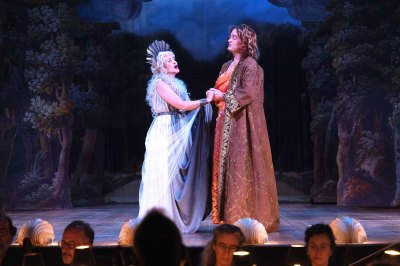
Louise-Geneviève Gillot de Saintonge is the librettist of Circé, as she is of Didon, another early work by Desmarest – rediscovered two years ago. The queen and magician Circé is a woman depicted by a woman: a daring, rare occurrence in the 17th century. The opera is inspired by the Odyssey and has as its setting Ulysses’s stay on the sorcerer’s island. A daughter of the Sun god Helios and the Oceanid nymph Perse, she is an enchantress and a minor goddess in ancient Greek mythology and religion, renowned for her vast knowledge of potions and herbs. She is madly in love with Ulysses; the latter ostensibly returns her love, but does so only out of trickery, to ward off being bewitched. He still loves Éolie, a nymph who lands on the island at the start of Act III. Another nymph, Astérie, who is close to Circé, is in love with a member of Ulysses’ retinue, Polite. But she is coveted by Elphénor, whom she rejects.
The intertwining of these gallant intrigues gives rise to a succession of scenes of spite and love, jealousy and tenderness. Only Éolie’s appearance in the middle of Act IV, in search of Ulysses, unaware that he is being tortured by the Eumenides whom Circé invoked, reconsiders a topos in an unexpected way. Lost, unable to find her way, she exclaims: “Alas! one easily gets lost / When one has only Love as a guide,” giving meaning to the situation she finds herself in, confirming the traditional moral lesson that being in love makes one blind and alters
one’s judgment.
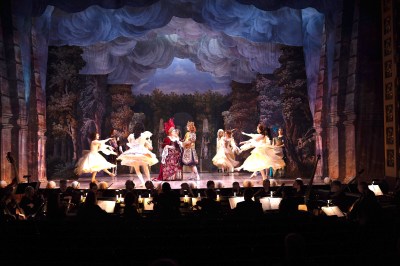
The choreographers Marie-Nathalie Lacoursière and Pierre-François Dollé deftly weave the dance numbers into the overall framework of the action, and their elegant and evocative movements generate powerful imagery and emotion. Theirs is a rich tapestry, depicting the agonies and ecstasies of the mighty forces and figures of the classical world, at times simply conveying delight in the movements themselves. The choreography is so vivid, so layered, that one could get happily lost in it. This is great story-telling through dance.
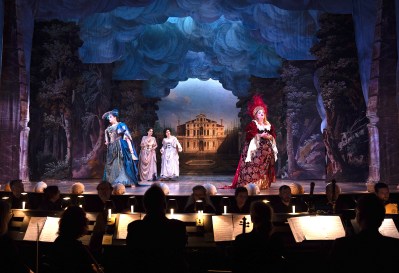
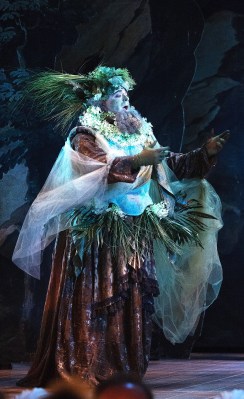
Stage director and set designer Gilbert Blin immerses the actors and audience in the world of Circé’s characters thanks to his creation of sets deeply informed by the libretto’s lyric beauty and the music itself, tinged by a melancholy evocative of Keats’ “Ode on a Grecian Urn.” This is a Circé that asks the big questions of existence while framing them within the life story of the famous goddess who possesses the magic power to transform beings from one form into another. Circé knows the gods of Olympus and the heroes of ancient Greece, and we see them through her perceptive eyes. The opulence of the stage sets brings to mind the revival of color and movement found in the paintings of Nicolas Poussin, Charles Le Brun, Pierre Mignard and Antoine Watteau. It also evokes the intimacy of the boudoir whether in domestic scenes or in pastoral idylls. Jérôme Kaplan bases the costumes on historical sources, making them lavish in detail and embellishment. He recycled many of the costumes from previous BEMF’s productions even turning some of them inside out. A welcome gesture that aligns with nowadays ecology’s concerns reducing the amount of waste sent to landfills and incinerators. The painterly and poetic nymphs’ dresses are informed by period styles as he knew exactly which fabrics to use and how the flowing pieces should be cut and decorated. In short, this is about as close as we will ever come to the feeling we are actually entering the world of mythology.
Musically, the opera adheres closely to the style of Lully, however the orchestration seems richer in places. For instance, the intervention of the bassoons at the end of Elphénor’s recitative, “The inhumane me flees” and the expressive “Finally he is in my power” are particularly striking. The male trio during Ulysses sleep scene, directly inspired by Lully’s setting of the sleep of Atys, is of an astonishing melodic and harmonic invention. Desmarais has already used the same setting in his 1686 opera La Diane de Fontainebleau. We can also point to the opening aria of Éolie, at the beginning of Act III, which is very euphonious, and the skillful evocation of “chaos” provoked by Circé just before the final curtain drops. The shift at the ending from Lully’s style towards a more harmonic one is also notable. The BEMF orchestra added foley effects and an aeoliphone – more commonly known as a wind machine – to emulate different sounds found in nature. (The aeoliphone made its first appearance in Rameau’s 1763 opera les Boréales.) It should also be noted that the BEMF recording made in Bremen a year ago may reveal other, unexpected riches contained in Desmarest’s score, since Circé was performed there by another soloist. This tragédie en musique is not a seminal work in the history of that genre in France, but it is a beautifully crafted one.
The BEMF Orchestra has accustomed us to music-making close to perfection, and this occasion is no different. The solo passages of the instrumentalists testify to their confidence and their commitment. Let us mention the following: Paul O’Dette (theorbo) and Stephen Stubbs (Baroque guitar); Robert Mealy (dessus de violon); Michelle Humphreys (numerous percussion instruments); and Dominic Teresi and Allen Hamrick (bassoons).
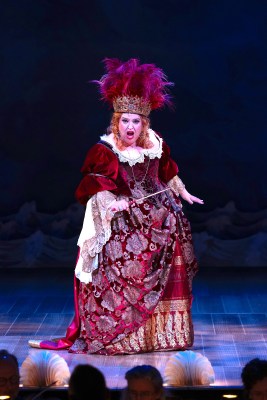
Wearing a scarlet dress adorned with a royal feather head-piece, soprano Karina Gauvin is an imposing presence as Circé. She possesses fluid legato, brilliant and precise coloratura, rich chest voice, and marvelous dynamic control, though at times her projection is a little weak. Her voice retains its qualities of declamation throughout. Amorous, she wavers between love : “I know how to love than to hate” and strength “But the more I fell love for you / the more you should fear the revenge that drives me.” This and her haughty bearing help give an elegant and powerful dimension to the character, especially in the final scene.
Facing her, tenor Aaron Sheehan is an energetic Ulisse. Is he really in love? Or only fickle? Or just plain cunning? As his affections shifts between Circé and Éolie these traits perfectly convey the gallant dimension of Saintonge and Desmarest’s character. We always admire his polished, lovely tone and a declamatory clarity which allows the listener immediate access to the musical line and the text.
Baritone Jesse Blumberg, one of my favorite soloists because of his impeccable diction, is assigned a typical Lullian role, and the darkest one in the work, that of the jealous Elphénor, who puts an end to his own life in Act III. His slightly exaggerated expressiveness is perhaps not in the purest style of lyrical tragedy, but it proved to be of formidable efficacy: all his character’s musical interventions are marked by a beautiful, singular charge.
Soprano Teresa Wakim, whose singing is notable for its delicate nuances portrays an assertive Astérie and is a beautiful presence. She sings her top notes full-throated, with timbre and dynamic control enunciating the text boldly. Amanda Forsythe’s Éolie is full of charm and character. The veteran singer is gifted with very great expressiveness, combined with a velvety timbre. Douglas William is a solid and elegant Polite.
The choir sings with the clarity of speech. We quickly note that each of its members could have been a soloist, especially when we hear the magnificent high register of Hannah De Priest as Cupid and as nymph, not to mention the vocal colors and authority of Mireille Lebel as Minerve. Jason McStoots, Michael Galvin, and Jonathan Woody, who appear in the minor solo roles of Phantase, Phaebetor, and the priest in the temple of love, are also remarkable.
Kathleen Fay’s production of Circé bears the stamp of the heroine’s own transformative magic: an abundance of beauty, adventure, reinvention. And yes, she is a woman in love more than simply a magician, a feminine approach to the character in which delicacy is mixed with rage. Through the charm and spells of a misfit heroine, the world of the gods becomes astonishingly alive and the world of our own humanity — its questions, loves, and bonds — is touchingly illuminated. It is a substantial and splendidly executed effort that fully deserved the rousing applause and cheers it received. One almost expected The Sun King to appear and join in the celebration…..
This production was produced in partnership with the Centre de musique baroque de Versailles
https://bemf.org
DIRECTORS
Musical Directors: Paul O’Dette and Stephen Stubbs
Stage Director: Gilbert Blin
Orchestra Director: Robert Mealy
Dance Director: Melinda Sullivan
Choreography: Marie-Nathalie Lacoursière and Pierre-François Dollé
Costumes Desiggn: Jérôme Kaplan
Sets design: Gilbert Blin.
CAST
Karina Gauvin, Circé
Aaron Sheehan, Ulisse
Teresa Wakim, Astérie
Jesse Blumberg, Elphénor
Amanda Forsythe, Éolie
Douglas Williams, Polite
Hannah De Priest
Nola Richardson
Mindy Ella Chu
Mireille Lebel
Brian Giebler
Jason McStoots
James Reese
Kyle Stegall
Daniel Fridley
Michael Galvin
Jonathan Woody
Ashley Mulcahy
David Evans

