Nélida Nassar 17 September 2021


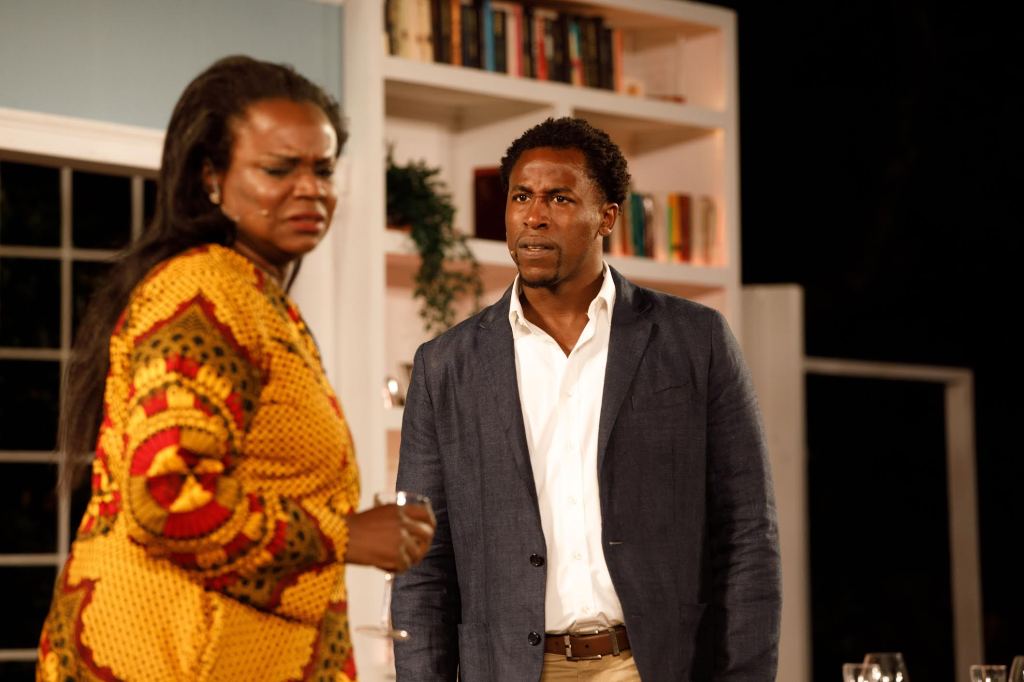

James Sheldon’s latest play, Reparations, now on the Gloucester Stage of the bucolic, sprawling Windhover Center for the Performing Arts, argues that there is no future for a people that denies its past, its intersectionality and the complexity of its identity. The author takes the discussion a step further by suggesting that a fixation with history can also be deeply damaging. He delivers a powerful and gripping story, animated by a fierce sense of social justice. It is fascinating to see a writer pursuing his own internal dialectic, but there are moments here when the action seems rigged in pursuit of the ideas.
The setting is the house of a recently widowed white book editor, Ginny Pleasance (Angela Pierce), grieving over the death of her husband, a prominent professor. She invites a young black writer, Reg Ambrose (Jason Bowen), to her apartment following a book launch reception. Both are eager to get into bed, but a night of tenderness and passion turns into a brutal morning-after when Ambrose threatens to reveal a dark secret about her past unless she publishes his debut novel. When Ginny’s wealthy old friends, novelist and publisher Alistair Jacobs (Malcolm Ingram) and his wife Dr. Millicent Jacobs (Lisa Tharps), a Nigerian physician, join them for an ill-timed paella feast, all four must confront a deeply ugly history and are soon embroiled as well in a debate over whether the young writer is due reparations. In the process, each of their hidden skeletons is revealed.
Reg faces fierce opposition when he announces that reparation should be paid to him and not to any other victims. He insists on exposing the racial divide between the 4 characters and the wider society, destroying his credibility as a cultural warrior, but even as the others begin to come around to his position, he remains openly defiant. Will he succeed in his blackmail attempt and claim his reparations for a life of perceived racial injustice, or will Ginny force his hand and seize her own emotional reparations?
Sheldon’s arguments are fascinating and as in Tracy Letts’s August: Osage County, David Lindsay-Abaire’s Rabbit Hole, he acknowledges the tensions between Black and Whites, and within dysfunctional families, as well as exploring bereavement and the trauma of sexual victims. But this play suffers from its own form of confusion. Emotionally, Sheldon sympathizes with Reg Ambrose. Yet he also seems to side with the character who claims “These institutions, which have been with us for hundreds of years, are built on the very idea that a bit of abuse is good for young men, to toughen them up for the day they have to go out into the world.” While applauding the work for its honesty and lucid realism, I feel it introduces too many themes: the private battle between Reg and Alistair pressuring the latter to recognize his carnal experiences; the conflicts Ginny experiences between race-baiting and asking for forgiveness; the dark past Millicent experienced in Nigeria; the running conflict between the traditionalists and the radicals who want to focus on historical reparations to African-Americans and not on other abused groups. By the end of the evening, one’s head is swimming from an over-abundance
of material.
Fortunately, Myriam Cyr provides the structure needed for a successful performance
of this play injecting it with compassion, insightfulness and searing candor in it intense emotional examination of grief. Her incisive social observations are at the core of a
prolific career in which she has never lost her passion for a popular theatre that addresses serious issues. Under her sympathetic, subtle and imaginative direction, Malcolm Ingram gives a brilliant performance as the disintegrating hero, full of ruined grandeur. Jason Bowen conveys both his obsessive wish to get his book published and his passionate conviction of what he thinks he is owed. Angela Pierce and Lisa Tharps, both victims, one of deceit and the other of rape, also offer strong performances, though the former’s original and striking portrayal of the betrayed wife, creates an identification with Ginny that make her acts of soul-searching all the more compelling. There is no denying that the play is full of moment-to-moment dramatic power. But the big question is how one can manage to understand and repair the past without being submerged by it. James Sheldon has no very clear answer. Still, his kind of popular theatre, to which he is committed and which, he fears, is waning in our market-driven world, has a strong new entry in Reparations. The play has, I believe, the power to enrich and enlarge people’s lives, and I hope it reaches the wide audience it deserves. NN
At the Windhover Center for the Performing Arts, Rockport, MA, through Sept 19, 2021

