All posts by Nélida Nassar

The Magic of Jordi Savall

Nélida. Nassar 16 April 2025

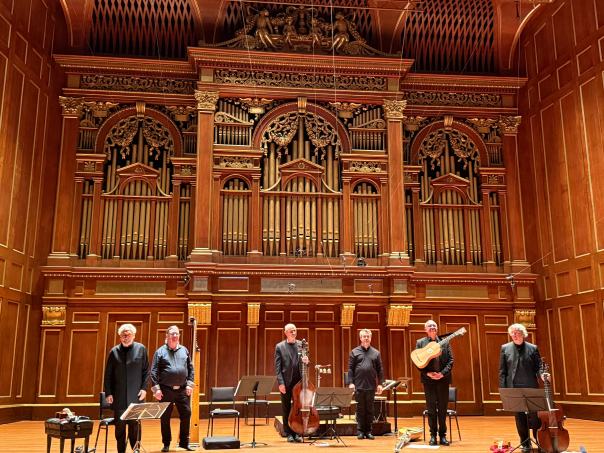
The magic of a musical evening often lies in the encounter between a venue, a repertoire, and one (or more) performer(s). It was this magic that defined the closing concert of the Boston Early Music Festival 2024-2025 season Sunday, April 13. The venue: Jordan Hall with its unique architecture in the heart of Boston with excellent acoustics, where all seats on both the main floor and horseshoe-shaped balcony have unobstructed views of the stage. The program: Entitled Music of Fire and Love: Folías, Battles, and Lamenti; Glosado, Variations and Improvisations where Maestro Jordi Savall with his legendary ensemble Hespèrion XXI, reunite a group of exceptional musicians, each a specialist in historical instruments bringing centuries-old compositions to life. A program standing out for its combination of rigorous research and high-quality musical interpretation, offered the audience a sonic journey through European and South American music of that period notwithstanding great wit. The performers: Joining Savall were Xavier Díaz-Latorre (Italian Baroque triple harp and Spanish Baroque harp), Andrew Lawrence-King (arpa doppia), Philippe Pierlot (treble and bass viols), Xavier Puertas (violone), and David Mayoral (percussion), with Savall himself as the director and performing on the treble viols. The musicians’ beautifully blended sound was obvious from the very first notes, and their pleasure in playing together – relishing the give and take of the civilized, conversational music – was tangible. This new tour across the United States is a project that is presented in a total of six concerts across the American continent. Boston was its third destination. Jordi Savall is one of the most versatile musical personalities of his generation. For more than fifty years, he has rescued musical gems from the obscurity of neglect and oblivion and given them back for all to enjoy. A conductor who draws the world together, he has been called a magical musician, a time traveler, a globe-trotting adventurer, a tireless scholar, a virtuoso performer and a visionary ensemble leader. We may not know exactly where Savall will lead us next as he mines the past for treasures that illuminate new connections between historic people and places, cultures, and movements, but we are always thrilled to come along for the ride. His loyal and enthusiastic following which turned up in force at Jordan Hall could not be satisfied until two encores had been granted, taking us even further afield, to Scotland and Peru. One thing is clear, Jordi Savall is a gift to us all.

The Doctor: A State-Of-The-World Debate about Our Contemporary Ills

Nélida Nassar 08.19.2023

Award-winning writer and theatre director Robert Icke specializes in updating the classics in a post-modern, polystylist manner. An adept of literary Darwinism, he rejects objectivism on principle, and systematically condemns any “reductionist” approach. This is evident in The Doctor. The work is a loose, subtle and astonishing adaptation of Professor Bernhardi, one of the best known plays of the Austro-Hungarian dramatist, short story writer and novelist Arthur Schnitzler. It was written in 1912, in Vienna’s “Last Waltz” period. In this brilliant expansion of the original plays’s themes, Icke takes on not just religion but also gender, government cowardice, office-hierarchy jockeying, anti-élitist fervor, race, wokeism and class. 

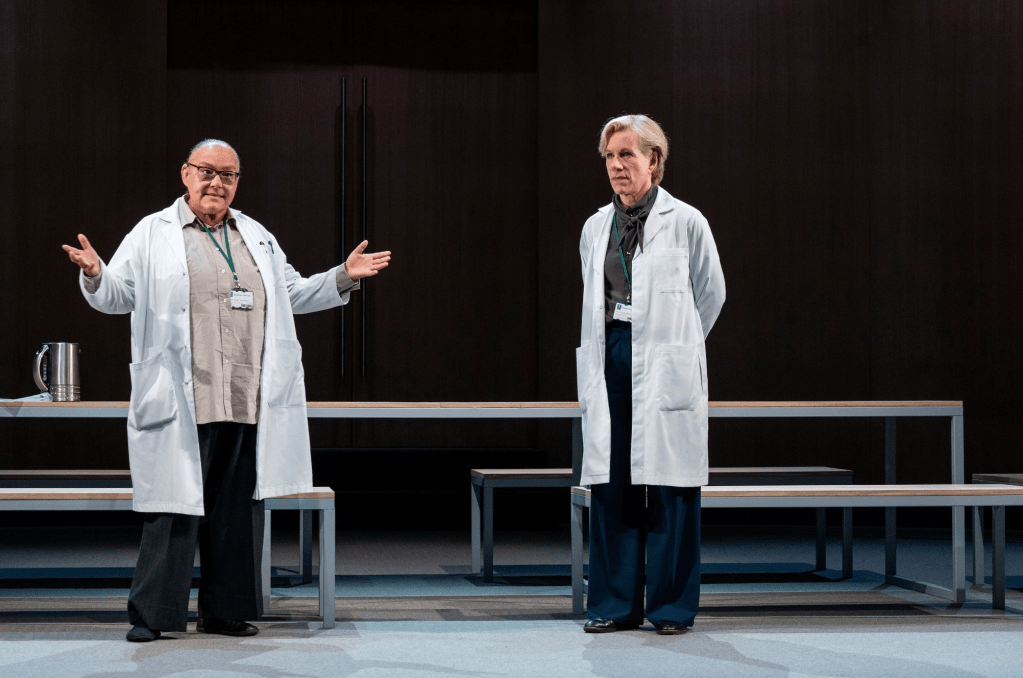
The brilliant Dee Nelson appeared as Ruth Woolf, replacing the enormously talented Juliet Stevenson, who fell ill, for the last performances at the Park Avenue Armory. The two-hour-and-forty-five-minute show keeps Nelson onstage for almost its entire length, even during the intermission. The eponymous hero is a secular Jew who runs a prestigious institute for nervous disorders. In the first act, she refuses to allow a Catholic priest to minister to an ailing 14-year-old girl patient, whom she admitted in exceptional circumstances and who is dying of sepsis from a self-administered abortion. Her reasons are strictly medical: she would prefer that the girl die in a drugged euphoria from a dose of camphor she gave her and unaware of her imminent death. But, when the patient dies without receiving the last rites, the incident begins a turbulent and soon to be public confrontation. It goes viral on social media, provokes petitions and TV debates, and jeopardizes not only Ruth’s future but that of the institute itself and a new government-financed building. Ruth becomes the victim of a political witch-hunt. She is accused of “religious agitation”, arraigned in court, and driven out of her own hospital by its anti-Jewish faction.

At the heart of the play lie two crucial issues handled with exemplary fairness. One is whether medical ethics on its own supersedes all other considerations. The other, related, topic is the danger of constantly playing identity politics: as one of Ruth’s colleagues points out, it is irrelevant whether a doctor is white or black, godless or a believer, a woman or a man, and even more destructive to allow the professions to be judged by sanctimonious trolls.

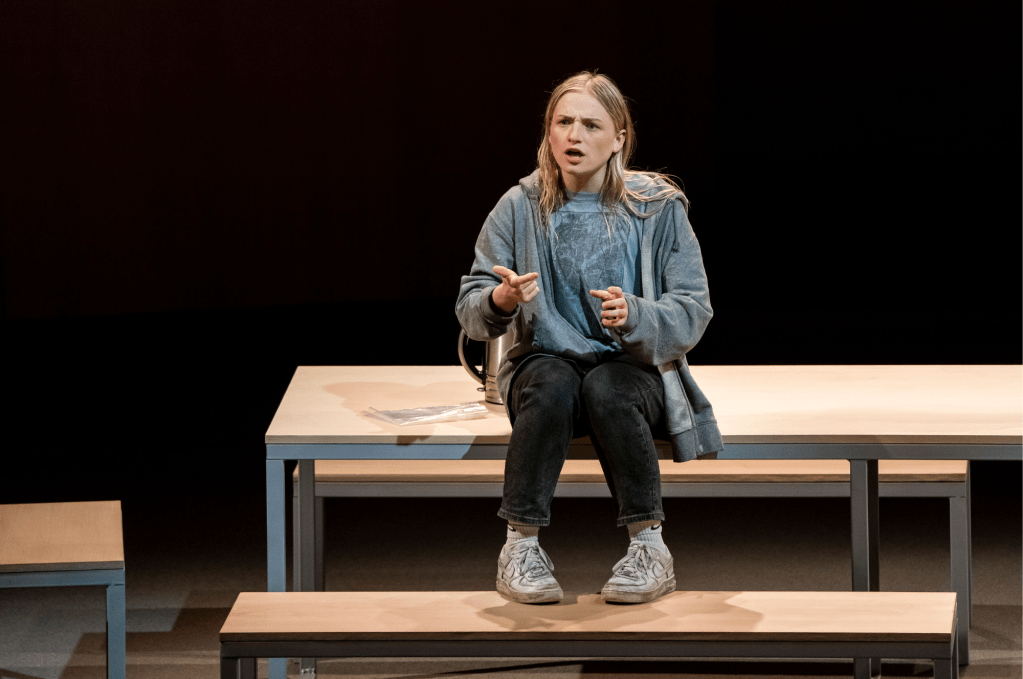
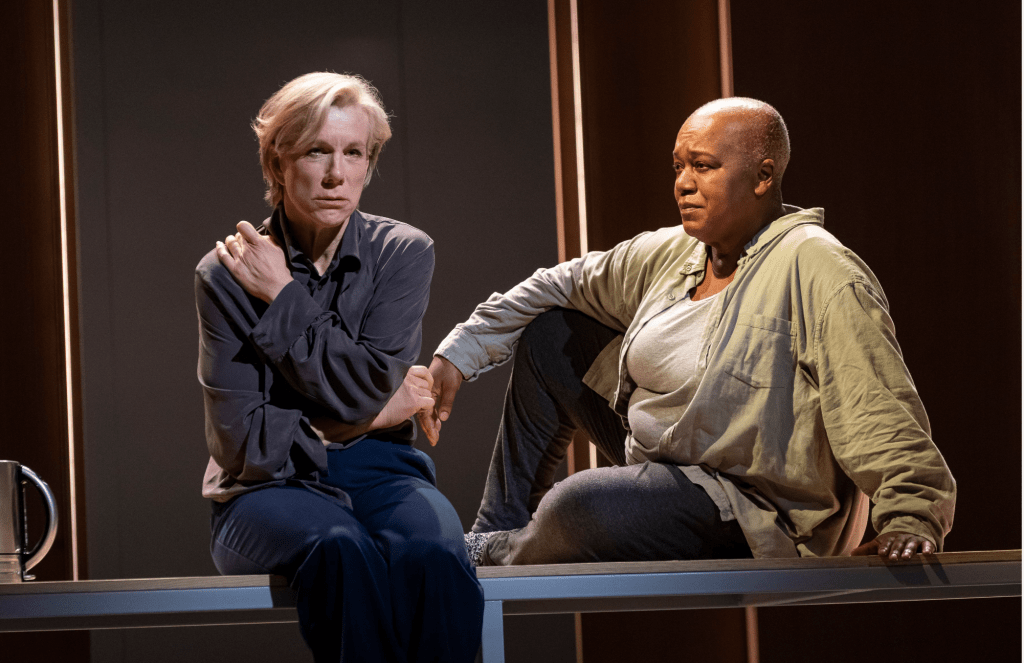
All of this is debated with unflinching clarity. Icke, following Schnitzler, shows his protagonist as a victim without totally exculpating her. Nelson hits the right note as Ruth by conveying both the doctor’s fundamental decency and her naive belief in the unassailability of truth. She shows Ruth to be politically naïve as well as brusque and intolerant of other people’s failings, especially in her vehemently expressed punctiliousness in criticizing misuses of language. But while Nelson shows how integrity can turn into inflexibility, she also beautifully portrays the human cost of making medicine one’s god. When seen close up during a hostile TV interview as she confronts the sacrifice of her relations with her betrayed homosexual lover Charlie (Juliet Garricks) and the transgender teenager Sami (Matilda Tucker) – who is struggling with gender identity and whom she mentors – her features memorably convey the pain of an unbearable sense of loss. Nelson’s consummate performance shows Ruth in all her complexity.

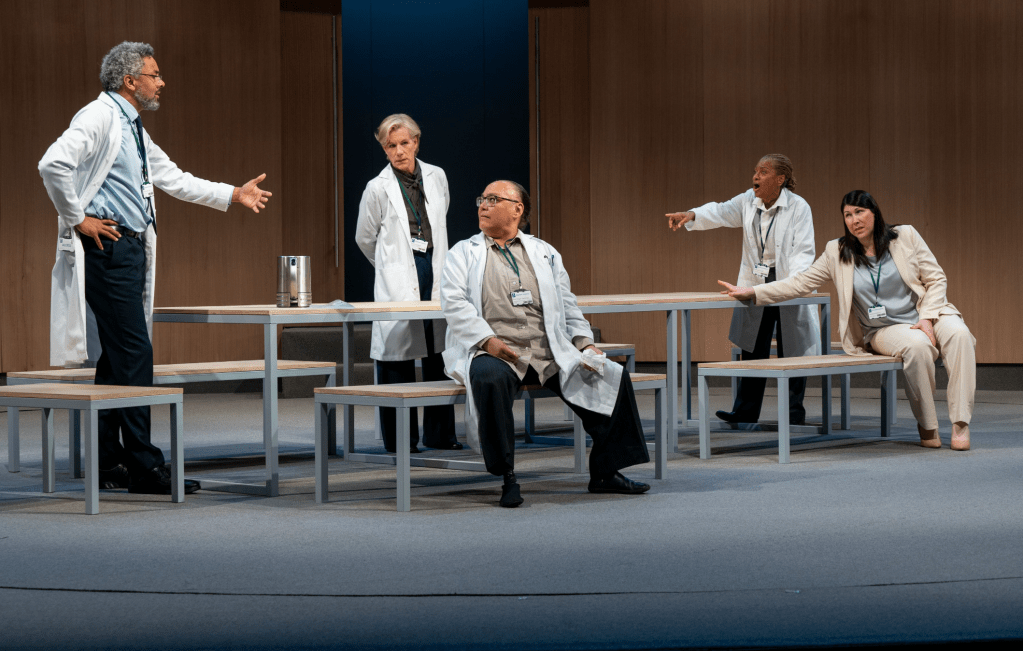
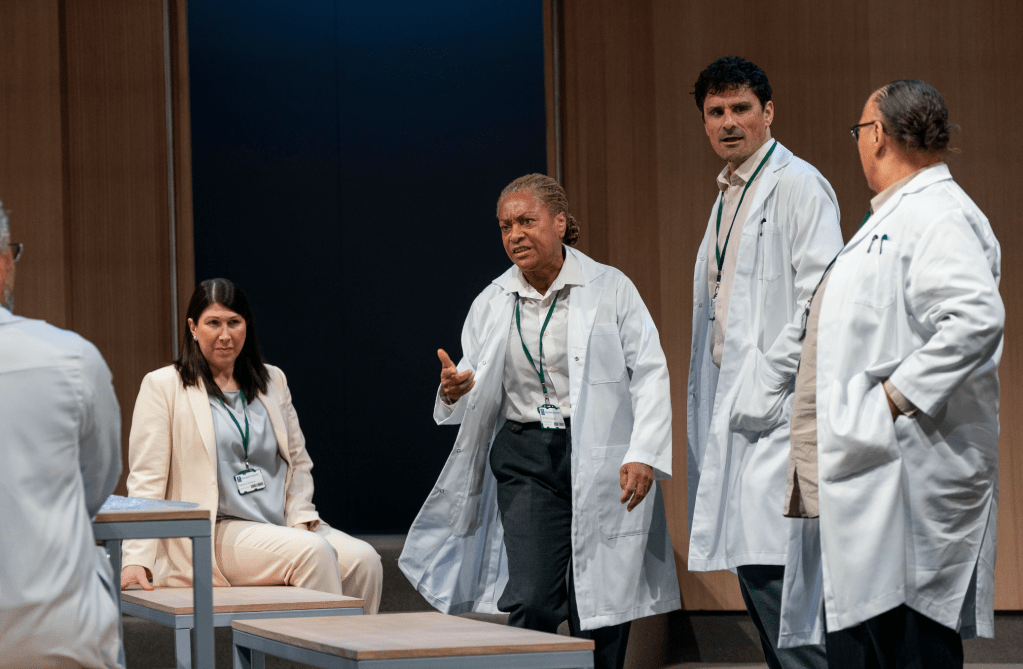
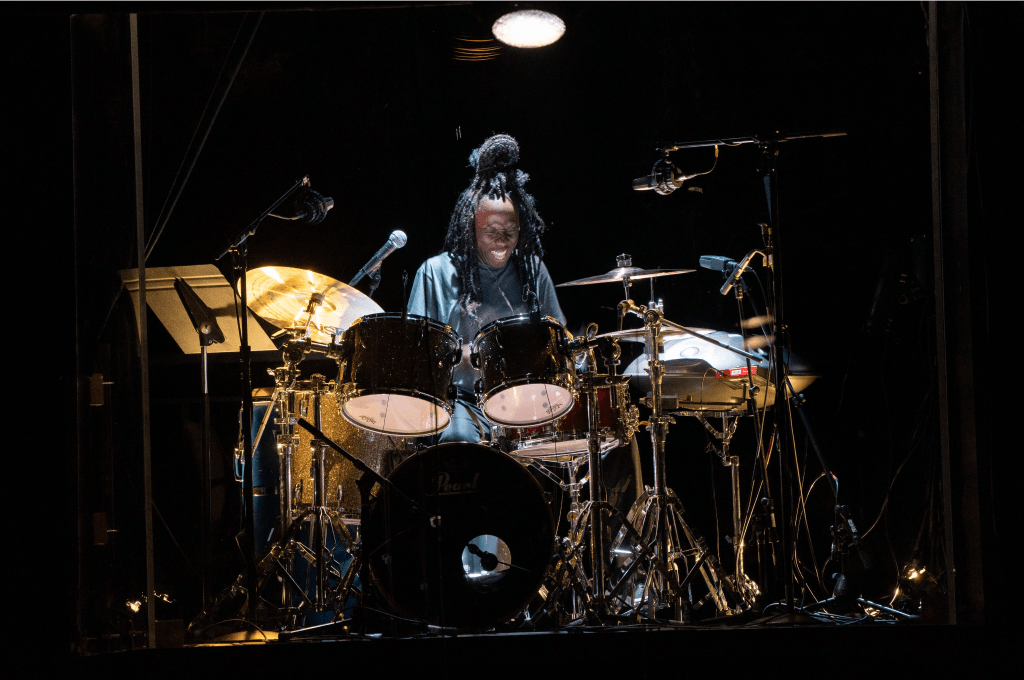
This production is impactful from the minimalist simplicity of Hildegard Bechtler’s gray-carpeted turntable stage design to the placing of the star drummer (Hannah Ledwidge) in a window high above the stage. Icke’s creative dissonance leads him to cast women in male roles and to have black actors play white characters (and vice versa), and they all inhabit their roles perfectly. Ruth is a white woman, and Dee Nelson is, too, but the other roles seem to be cast counter-gender: the executive committee includes two women playing men; and counter-race: Naomi Wirthner, a black woman plays Roger Hardiman the institute’s cofounder, as a vehemently anti-Jewish doctor and Ruth implacable opponent, Doña Croll the urbane civil servant is Brian Cyprian. John Mackay is the impassioned, spurned priest, a tall white man who is revealed to be black. They all perform with great skill. (The text notes that, apart from the TV scene, “each actor’s identity should be directly dissonant with their character’s.”)

What makes the play so satisfying is that Icke exposes the poisonous nature of our contemporary societal ills, including racism, without exculpating or sanctifying his hero. You sense the nasty factionalism throughout the play. He charts Ruth’s downfall as she tries to hold the board together in the face of a witches’ brew of identity politics, religion, science, virtue signaling and social media. She becomes the centerpiece of a virulent debate between faith and science. In a tense scene, she and her opponent, the priest – in an outstanding performance by John Mackay – seek to defend their religious and philosophical convictions. Ruth’s crime, as she tells the priest, is that “I don’t care about politics.” Ickes’s point is that political innocence is no defense in a society as divided as our own suggesting that the doctor and the priest, while dramatic antagonists, have more in common than they realize.

This theatre adaptation not only brims with energy but reminds us of Icke’s ability to turn social observation into prophetic insight. It also offers a complex reflection on our contemporary public life and stands in ironic relation to the conventions of tendentious drama. Philosophical arguments abound (think Shaw at his most pontificating) as do the practical issues that affect our lives today.    

Performances run June 3 – August 19, 2023  
Park Avenue Armory
Wade Thompson Drill Hall

CAST
Dee Nelson: Ruth Wolff
Juliet Garricks: Charlie
Daniel Rubin: Murphy
Naomi Wirthner: Hardiman
Christopher Osikanlu Colquhoun: Copley
John Mackay: Father
Doña Croll: Cyprian
Matilda Tucker: Sami
Mariah Louca: Roberts
Preeya Kalidas: Flint 
Matilda Tucker: Sami
Hannah Ledwidge Drummer and Additional Sound Compositions

The Doctor, Park Avenue Armory, 2023
Photo credit: Stephanie Berger
Photography: Park Avenue Armory
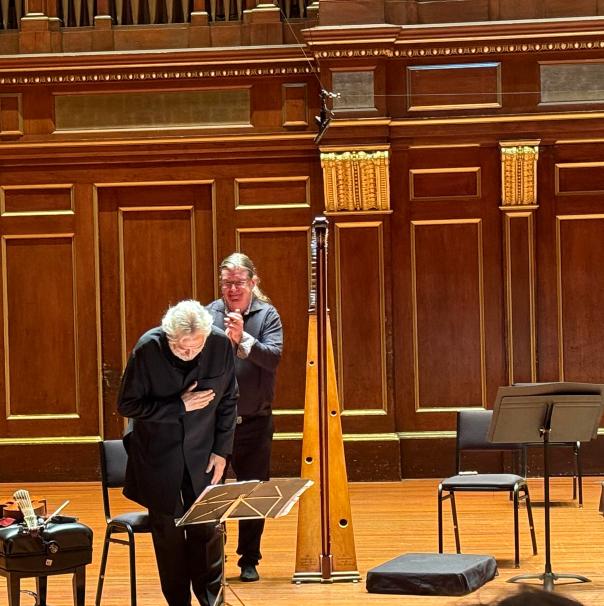
The Doctor, Park Avenue Armory, 2023
Photo credit: Stephanie Berger
Photography: Park Avenue Armory
Joseph Harb “Here and Now”: Memento Mori at Galerie Janine Rubeiz

A Collaboration: Artist Shawki Youssef and Poet Joseph Issaoui in “It is just a Poem”

Joyce El-Khoury at Exhilarating Opening of the Al Bustan Festival

Al Bustan International Festival for Music and the Performing Art Universalism versus Entropy 

Poignant Return of the Al Bustan International Festival of Music and the Performing Arts after an 18-Month Pause following the Pandemic and the Beirut Blast of the 4th of August 2020

Nélida Nassar 02.16.2022

For 28 years the Al Bustan International Festival of Music and the Performing Arts has held a special place in Lebanon’s cultural firmament, widely recognized as not only one of the city’s few major arts institutions, but also a destination for music lovers and the country’s only Spring festival.

The pandemic caused the Festival, like many others around the world, to cancel its entire 2020-2021 season. The gap was the longest since the festival began in 1994. Its enlightened founder, Mrs. Myrna Boustany, has passed the mantle to her daughter, Mrs. Laura Lahoud, who is carrying on her legacy with loyalty, charm, wit and poise.

For the first time in 550 days, an audience will be inside the auditorium in Beit Merri on Wednesday night, attending a performance of Puccini and Verdi’s opera arias by soprano Joyce El Khoury, noted for her sparkling, clear voice and stylistic sensitivity. She will be accompanied by pianist, conductor, and the festival’s artistic, director Gianluca Marcianó. The night will most likely also commemorate the hundreds of thousands of deaths caused by the coronavirus pandemic along with the disaster of the 4th of August 2020, which left the country with 218 deaths, 7,000 injuries, and US$15 billion in property damage, as well as an estimated 300,000 people homeless.

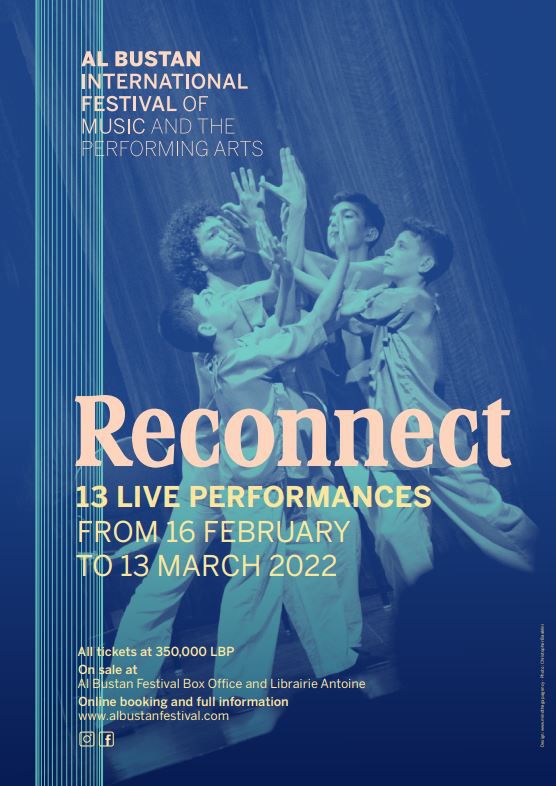
The festival is an occasion to reconnect with culture and art. Some in the audience will undoubtedly congratulate long unseen friends and acquaintances for making it through the 18 months. There may be a discreet speech from the stage. Thirteen live performances are planned for the season, which runs 4 weeks, from 16 February until 13 March 2022.

This 27th edition is entitled “Reconnect” and includes national and international performers, some of whom will give several consecutive performances, among them: The Royal Academy of London Quintet (Miles Ames, violin, Maria Reinon, violin, Luca Wadham, viola, Gloria Kim, cello, and James Trowbridge, bass);  pianist Boris Berezovsky, an especially fine interpreter of Beethoven; and a pianist of extremes Khatia Buniatishvili, known for her charismatic stage presence, warm, glowing tone and strongly expressed ideas. Violinist Renaud Capuçon, pianist Guillaume Bellom, and cellist Victor Julien-Laferrière will perform a selection of 22 of the works they developed and played during the pandemic.    

Local music groups will include the Lebanese Philharmonic Orchestra, under the baton
of Glass Marcano, performing Rossini’s William Tell Overture and Tchaikovsky’s Symphony
No. 4 
at Saint-Joseph Jesuit Church, Monot. Rasayel group with singer Oumeima el Khalil, pianist Hani Siblini and the Lebanese Oriental Orchestra, conducted by André Hajj, will feature choreographer Pierre Geagea and his group of deaf dancers. Several lectures will take place at the Sursock Museum Auditorium in Beirut, as well a few fund-raising events on behalf of non-profit organizations.

The overused words describing the Lebanese as resilient and resistant and the country as being like a Phoenix rising from the ashes are by now clichés. I would instead speak about persistence as a fundamental Lebanese trait and virtue: “We bend, we don’t break. We sway!” And in the context of the Festival, it is Music’s power which is essential in helping us remember who we are and how we belong during difficult and traumatic times. It allows us to create an emotional narrative between the past and present when we struggle to articulate such a narrative in words. Its familiarity comforts us when the future seems unclear. 

Music will return to the Al Bustan International Festival of Music and the Performing Arts’ proscenium tonight and, as always, in style. Opening night there is a marker of the start of Lebanon’s Spring social season. I cannot wait to bask in the rapturous applause of an audience starved for live music.

Astounding Mezzo-Soprano Ann Hallenberg with the Venice Baroque Orchestra

Ms. Hallenberg convincingly brings out the tragic dimensions of the operas, her facial expressions marking the changing moods of the score, even in moments when she is silent. Supported by a supple orchestra whose members seem to breathe along with each of her notes and who provide a lush background for her pure soprano tone, she reminds anyone who still doubts it that the opera seria is above all theater, as she deftly paints the painful and vindictive figure of the dazzling eunuch Vagaus, or the anguished Tamiri. Her most admirable quality, perhaps, is the eloquence with which she voices the text – of which we perceive every word. Governed by such mast

Kristian Bezuidenhout with Handel and Haydn Society: Boldness and Poetry