Nélida Nassar 30 March 2023
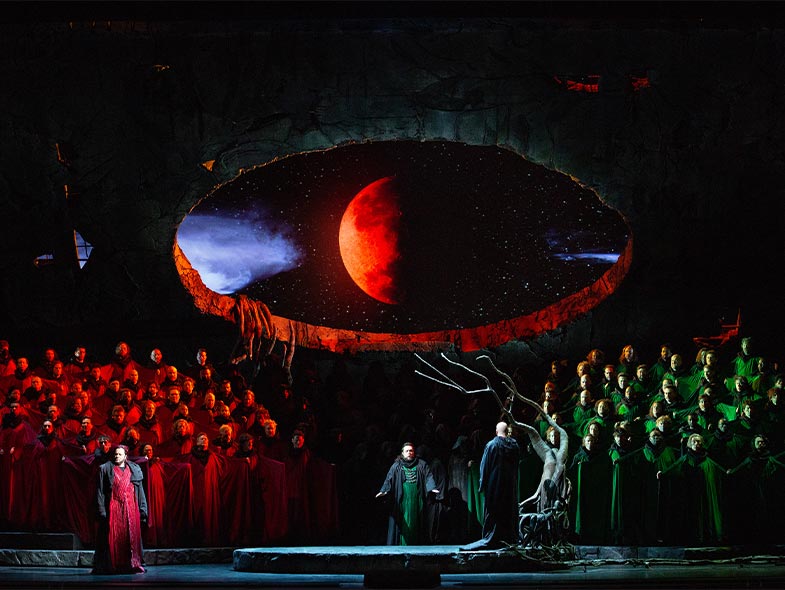
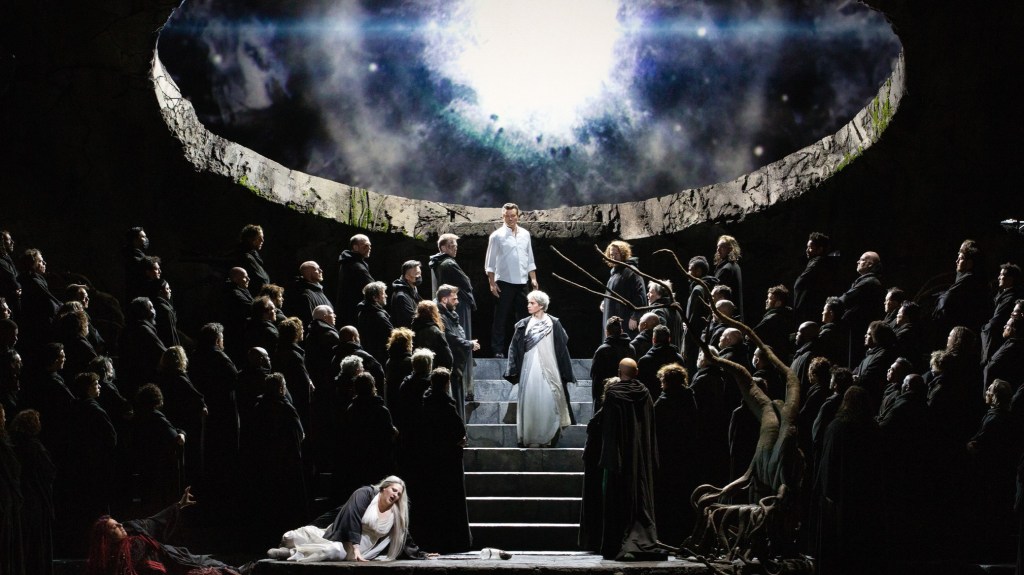
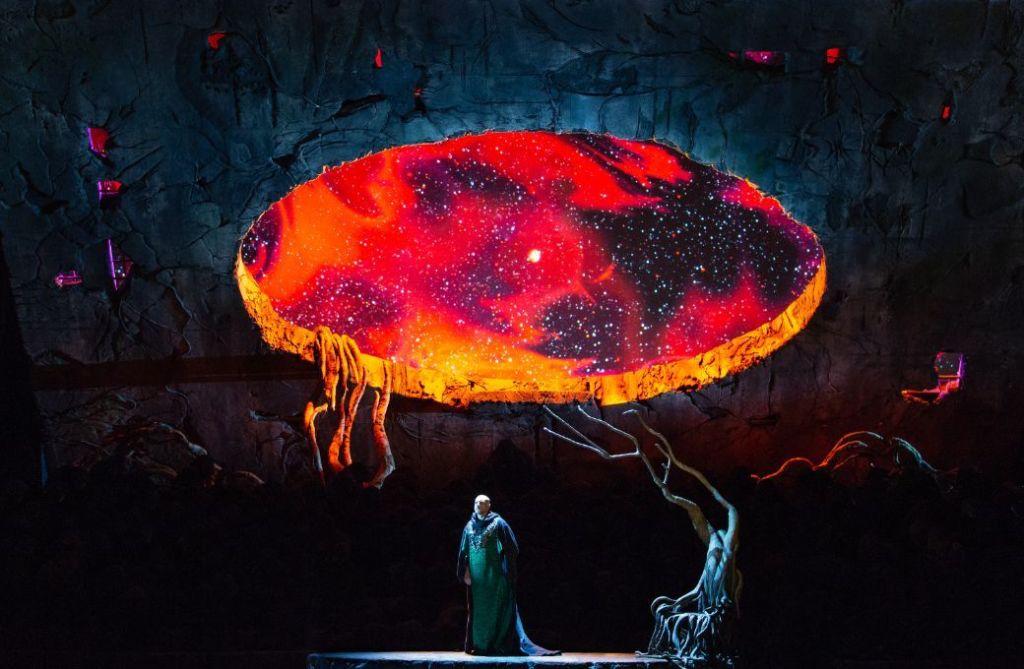
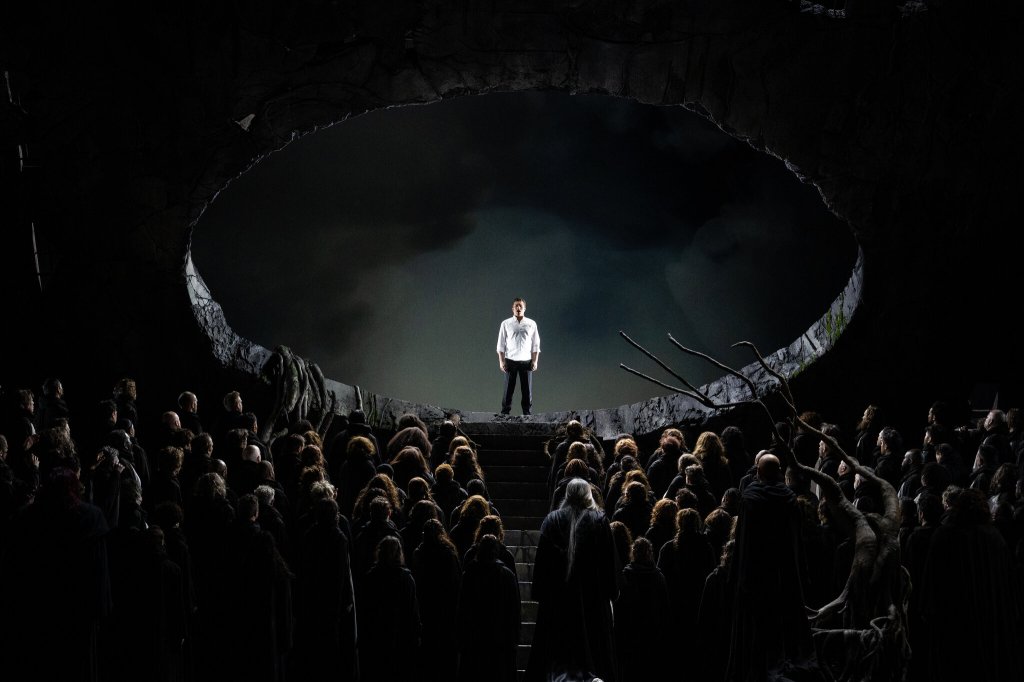
Lohengrin returns to the Metropolitan Opera stage after a seventeen-year absence in a new production by François Girard, who in 2013 produced a memorable Parsifal with Jonas Kaufmann, as well as The Flying Dutchman in 2020. For his third production at the Met the Quebec-based director places the action in a post-apocalyptic universe. The characters are trapped in a desolate landscape whose main feature is the vast, dark, underground overhang of a gigantic slab pierced with a large circular opening which allows them and us to see the starry sky, the galaxies, the passage of time and the moon at regular intervals. In the center of the stage, just below the opening, there is a grayish staircase. Most of the action takes place in front of this tilted wall with a big round void in it and with the heavens beyond, as if Gordon Matta-Clark had chain-sawed a tunnel from the duchy of Brabant straight through to us in hyperspace. To the side is a courtyard with a dead tree, a stump that serves as a throne for King Henry, known as the Birdcatcher.
The sets are by Tim Yip, as are the medieval-inspired costumes. The choristers are dressed in long black capes which, by a skillful arrangement of magnets, open alternately on different colored outfits. Green represents the king, red characterizes Ortrud, Telramund and the Brabant people, and white is the symbol of Elsa and of Lohengrin’s purity. Even the conductor Yannick Nézet-Seguin changes the color of his shirt from act to act to match these colors. This is quite an original idea and a lovely device to control 160 choristers and dancers, facilitating a sober but precise stage direction. The appearance of Lohengrin in the opening of the slab, dressed in a white shirt and black pants like Parsifal’s Grail knights from 2013, creates a link between the two productions. Although there are not many new ideas in this show, it is nonetheless effective, as evidenced by audience’s rapt attention to the various protagonists throughout the evening.
The cast includes some of today’s best interpreters of their respective characters, starting with tenor Piotr Beczala, who since 2019, when he first appeared in the role in Dresden, has matured to the point of offering us a Lohengrin close to the “ideal.” His gait and overall bearing are of a rare elegance, as if he were a being from another world. His uniformly limpid voice is remarkably projected in the great Act III duet with Elsa, one of the highlights of the evening. The tenor is capable of producing sonorities of pure beauty, especially in his “In fernem Land,” full of nostalgia and nuanced with infinite delicacy. This is great art! The entire scene that follows is declaimed with an intensity untroubled by any apparent sign of vocal fatigue. In his first role in German at the Met, Beczala revealed the full scope of his abilities as a heroic tenor, offering us a landmark performance.
By his side is Tamara Wilson who portrays Elsa with a pure timbre crowned by a radiant treble. In Wagner’s medieval epic, Elsa of Brabant is accused of murdering her brother. As champion to defend her honor, she calls upon a mysterious knight who has appeared to her in a dream. The knight has only one rule: Elsa must never ask him his name or origin. Right in the first act, in “Einsam in trüben Tagen” which she sings like a fervent prayer, Wilson’s diaphanous voice captures one’s attention. Torn between her love for Lohengrin and the doubts that Ortrud instills in her mind, she steadily and subtly builds a strong-willed character. Telramund’s wife Ortrud is vehemently played by Christine Goerke, who deploys a wide vocal range, rich in color. She is endowed with a sonorous low register and a powerful but sometimes raspy treble which accentuates the harmful and disturbing side of the character. Her gestures and her excessive mimicry, amplified in the cinema by close-ups, evoke at times the witches of cartoons, but her performance remains no less effective and striking. Evgeny Nikitin immediately impresses with his strong presence and the darkness of his timbre. Despite a perceptible vocal fatigue at times, his Telramund is fully convincing, especially in his big scene when the two confront each other. Günther Groissböck portrays an authoritarian and energetic king, with a solid voice that nevertheless peaks in the treble. Finally, Brian Mulligan’s powerful and intense royal herald does not go unnoticed. His means are already those of a Telramund, and he will, in fact, premiere that role next fall in San Francisco.
The opera contains some of Wagner’s best-known music, including the aria “In fernem Land,” the rousing Act III prelude, and the famous Bridal Chorus. Worth mentioning is the magnificent performance of the choirs prepared by Donald Palumbo, whose challenges in this work are particularly demanding. At the podium, Yannick Nézet-Séguin, who received a long ovation from the audience not only at the final curtain but also at the beginning of each act, offers limpid and shimmering direction and draws sumptuous sounds from his orchestra, in particular the delicately lyrical strings and the dazzling trumpets distributed in the pit and on the stage.
Gratefulto Fanthom *Let’s note for the record that this show was originally a co-production with the Bolshoi and that the premiere in Moscow took place at the time of the invasion of Ukraine in February 2022. The sets not having been repatriated, the Met had to have them rebuilt.
*Let’s note for the record that this show was originally a co-production with the Bolshoi and that the premiere in Moscow took place at the time of the invasion of Ukraine in February 2022. The sets not having been repatriated, the Met had to have them rebuilt.
Grateful to Fanthom Events for helping stream the Metropolitan Opera in HD

