Nélida Nassar 10.12.2021
Postponed for a year, the international Venice Biennale finally opened on May 22, 2021 in a city that was gradually receiving tourists again. For a time, in St. Mark’s Square more winged lions were seen there than passers-by: enough to flatter the aesthetic sense of the privileged visitors, but worrisome for the Venetians. If the pandemic has allowed them to reclaim the lagoon and its islands, the successive confinements have also been a “disaster” for some, as the local economy is dependent on tourism, though the way in which it has been practiced has been slowly destroying the city.
The year’s pause has not been simply a downtime. The pandemic confirmed the relevance of the question “How will we live together?” posed in 2020 by Hashim Sarkis, the curator of the 17th Venice Architecture Biennale and dean of the school of architecture at the Massachusetts Institute of Technology (MIT). “Our planet is facing a crisis that requires a global approach and global solutions so that we can hope to continue living on it together.” His question seems more and more prescient as the crisis following the pandemic takes on new dimensions. I believe, as he does, that ecological, social, economic, political or demographic crises reaffirm the fundamental role of architecture in imagining and achieving a better future for us all.
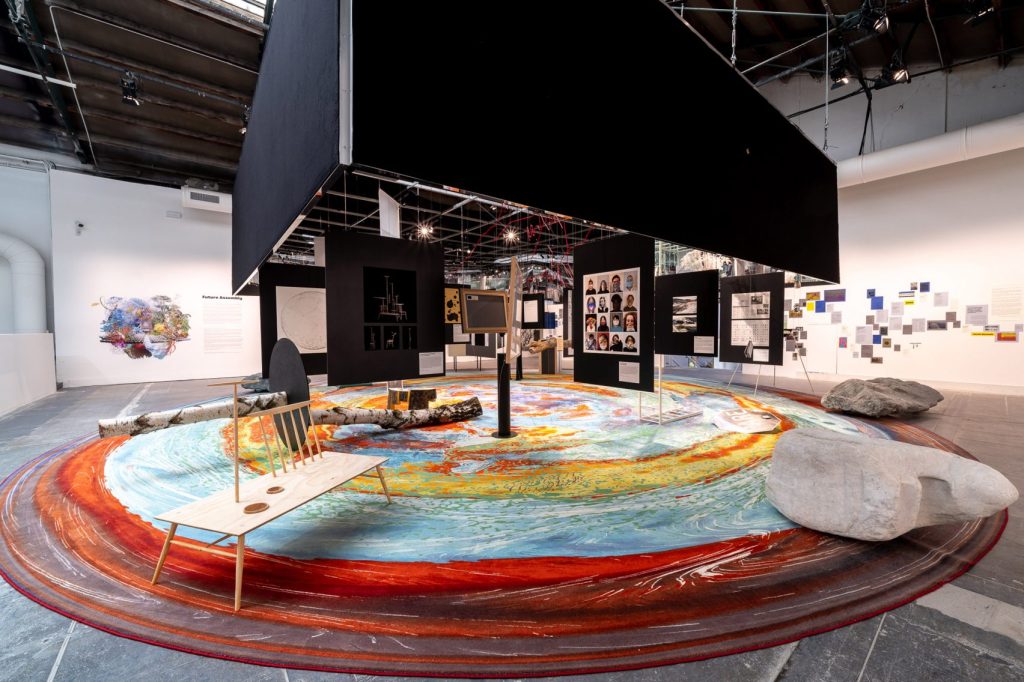
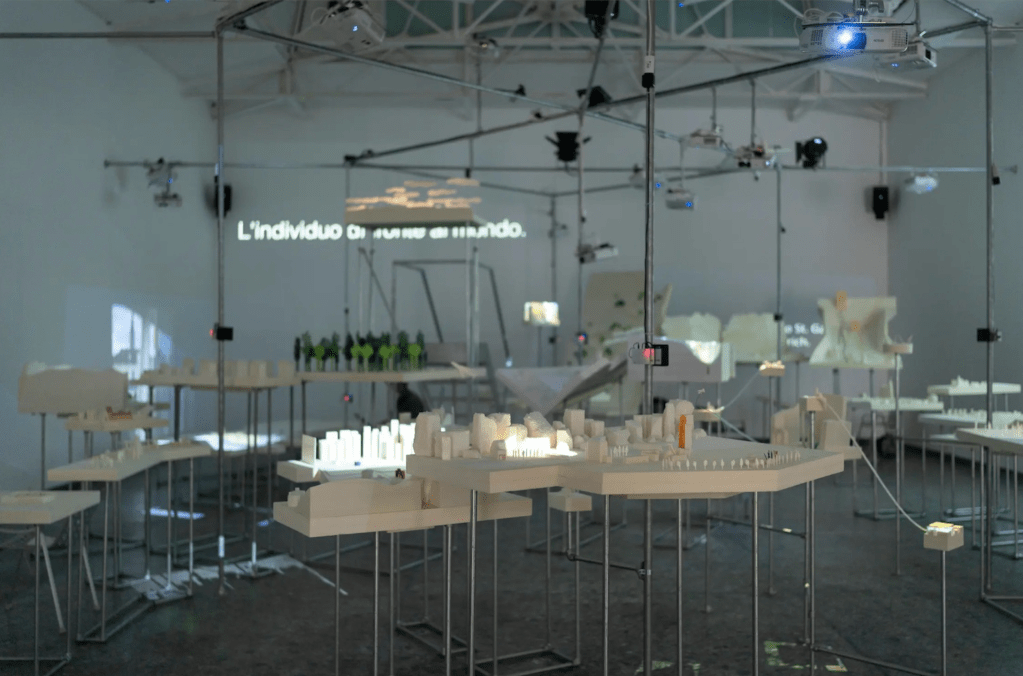
Experiencing the Biennale’s numerous exhibitions spaces is a fascinating if daunting experience. Let’s start with one that was inspired by a United Nations initiative and is chaired by the Icelandic-Danish artist Ólafur Elíasson. He suggests that we need a “more-than-human’s concept,” encompassing the whole environment from the earth’s crust to the smallest group of mushrooms, and that it should be integrated into the UN decision-making process. Unfortunately, this collective installation, by Studio Other Spaces (SOS), leaves even the person of good will helpless before the mountains of infographics to understand, texts to read, and QR codes to scan. A major exhibition occupying both the naval yard of the Arsenal and the central pavilion of the Giardini examines different dimensions of the theme of “living together”: among other living beings, in our new homes, as communities, across borders, and finally as a planet. But as the focus widens, the visitor retreats, once more crushed under the explanatory texts and the weight of the world’s problems. “How will we live together?” may be a simple, concrete and necessary question, but it certainly calls for complex answers which need to be clearly set forth. Sadly, here they are sometimes barely legible.
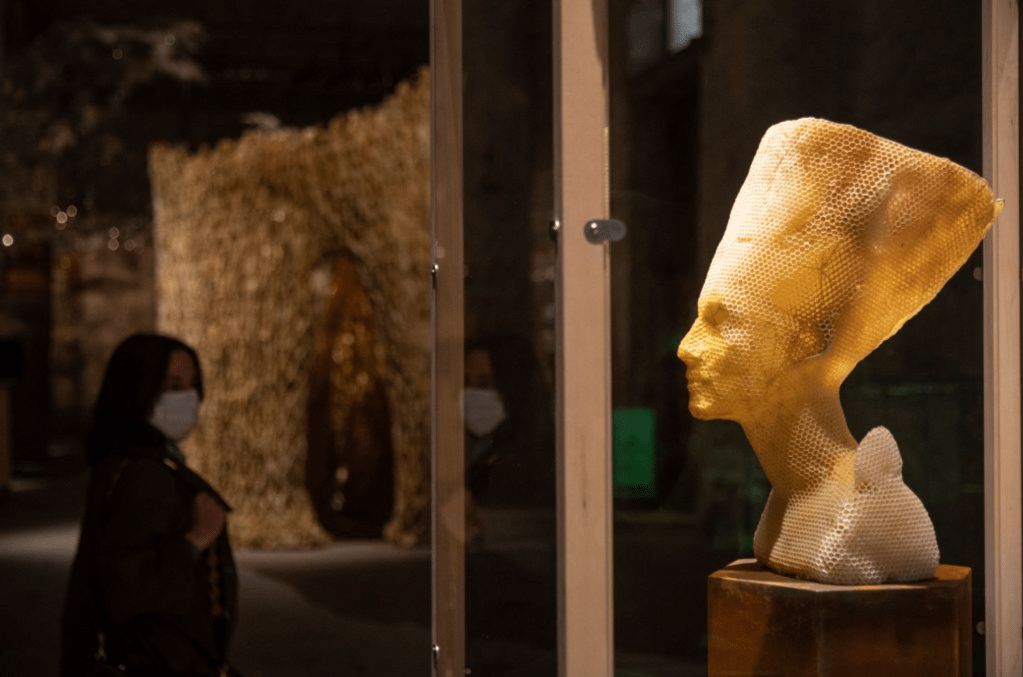
If this exhibition, chaotic, difficult, and fragmented, reflects the world as it is, it also emphasizes youth and pluralism, bringing together 112 participants from 46 countries and marking, in comparison with previous Biennales, an increased representation from Africa, Latin America and Asia. And in another change for the better there are as many women participants as men. This exhibit also included a few non-humans elements: mosses, algae, fungi or bees. 60,000 of them participated in the Beehive Architecture project, building on temporary frameworks (a bridge, a dome or Nefertiti’s bust) made of wax structures that are both complex and light. A tribute to the intelligence and power of nature, this project by Tomás Libertíny at Slovakia’s pavilion could serve as a poetic inspiration for the future of architecture.
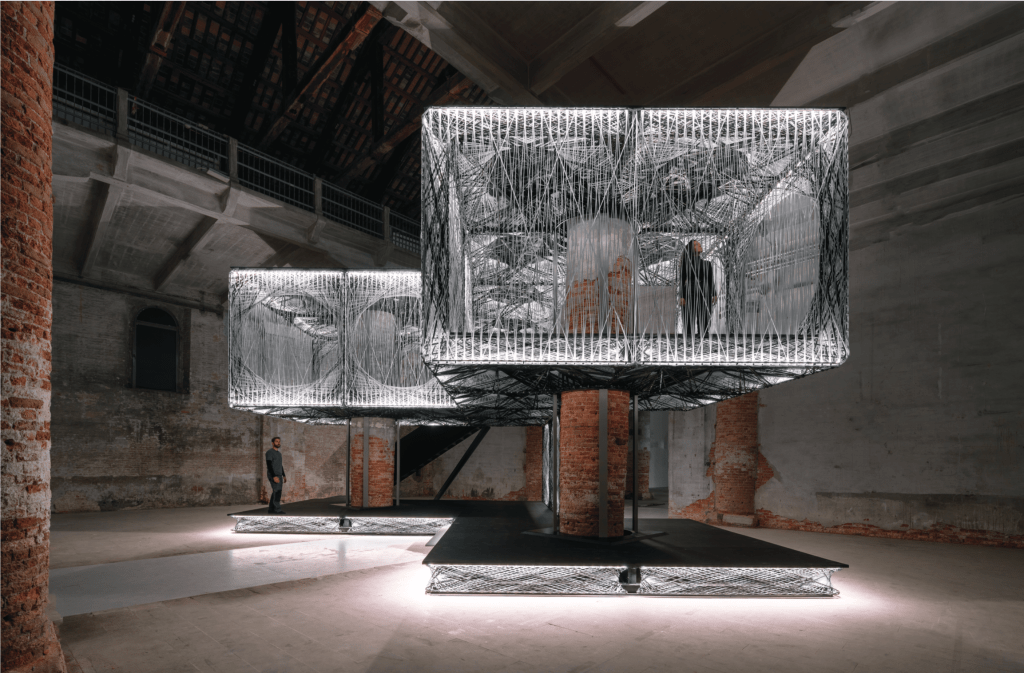
Responding to the now widely held view that the building sector is one of the most harmful human activities for the environment. two research institutes from the University of Stuttgart offer a vast installation about living daily life made up of glass fibers and carbon elements. Located in the Maison Fiber, it is an ultralight aerial structure that does not produce waste and promises a great change in ecological, economic, technical and socio-cultural terms.
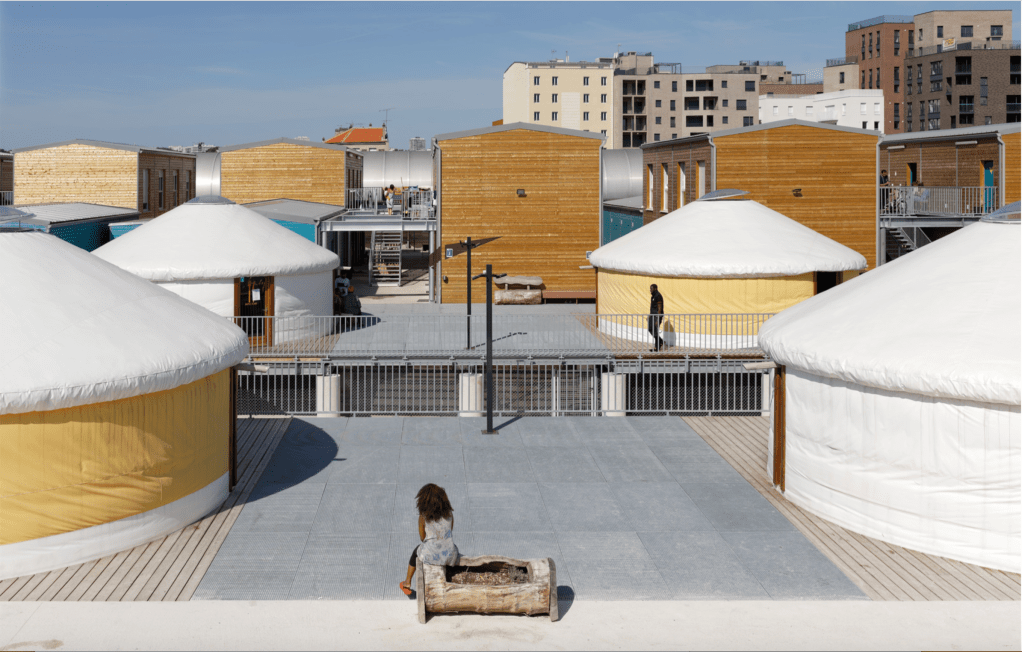
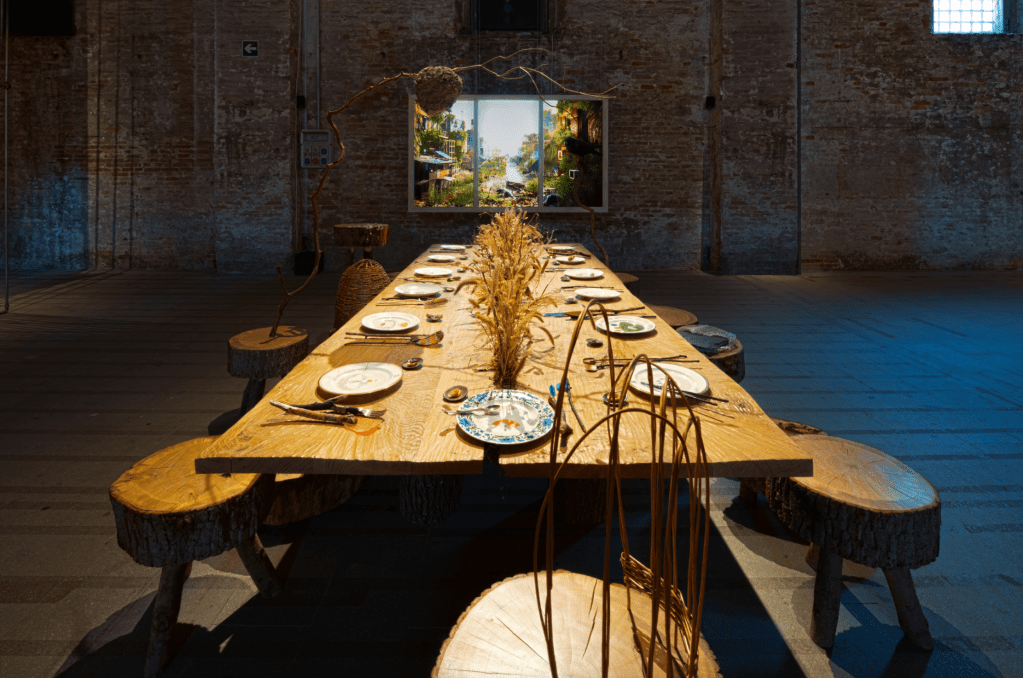
Listen Up is an installation that chooses not to detail the architecture of a place but to give voice to those who inhabit it. Designed by Rita Studio in Ivry-sur-Seine, France, it was the first emergency accommodation center for migrants and Romas and the winner of the 2017 architecture prize. Close-by is Refuge for Resurgence by Superflux, built with the means at hand. It invites humans, plants, animals, and mosses or mushrooms to a banquet that is composed of the ruins of our modernity. At the end of the table on sees on a screen, a window into our future: a depopulated urban center where nature seems to have reclaimed her rights, where we are all potential refugees.
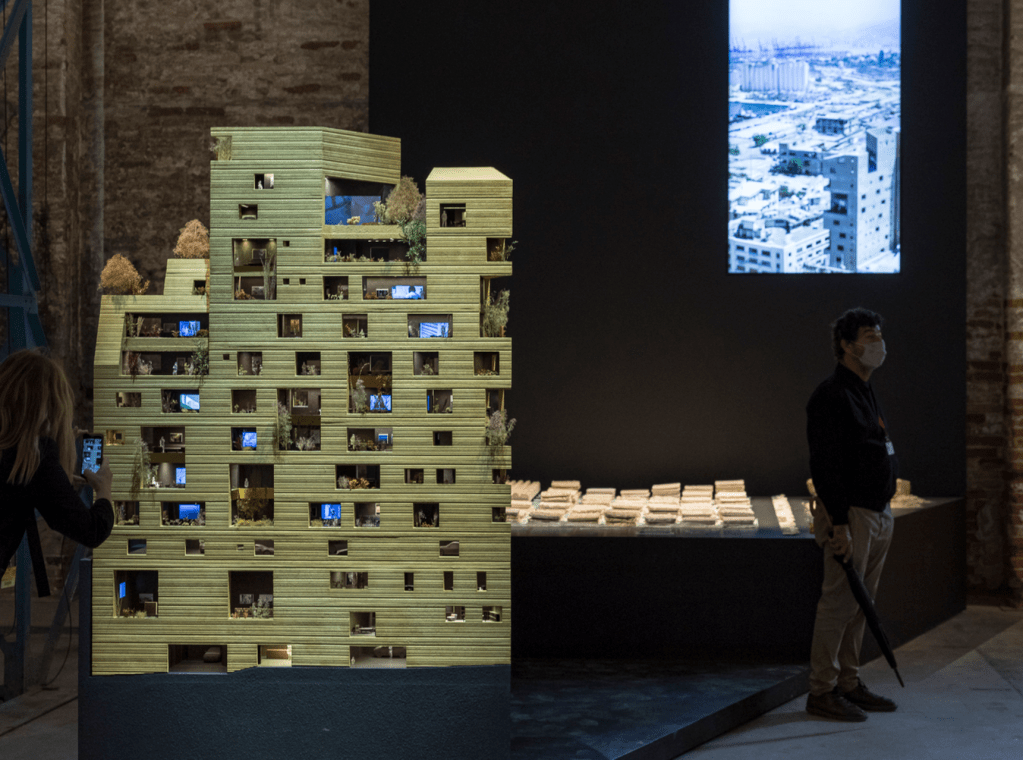
In the face of past and future disasters architecture can be an instrument of resistance and resilience. This is what the Franco-Lebanese architect – among the Biennale’s invited architects – Lina Ghotmeh advocates with Resilient Living: an Archeology of the Future, which exhibits a model of Stone Garden, her recently completed tower in Beirut not far from the port of Beirut where the double explosion of August 4, 2020 took place. From its asymmetrical windows the visitor, like a giant voyeur, can examine the interiors where translucent silhouettes stand guard. On tiny screens, videos project the history of the Lebanese capital and randomly broadcast images of the explosion. The immobility of the model and of the frozen, stunned, dumbfounded inhabitants contrasts with the terrible explosion that swept away everything in its path. On August 4, the apartment building, which also houses a photography foundation and a gallery, resisted, protecting its residents and neighboring homes. Ghotmeh presents this model as a contemporary artifact, an optimistic and generous witness, welcoming nature and life to the heart of the city.
Throughout the Biennale, the global crisis seems to have become the pretext for convoluted installations like Melting Landscape by Kei Kahoh Architects, a giant ice cube which, despite its insulating envelope, inexorably melts – so that an attendant must come regularly to mop up its surrounding floor. In attempting to grasp the point of the exhibit, the visitor herself may feel her mind is liquefying as well.
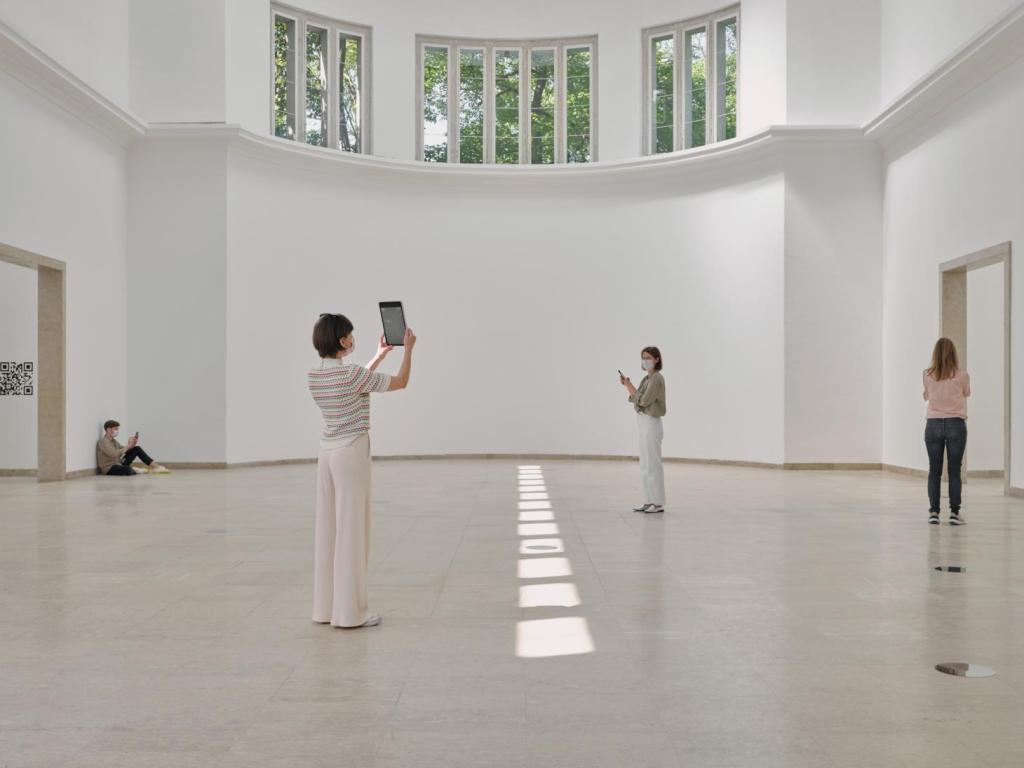
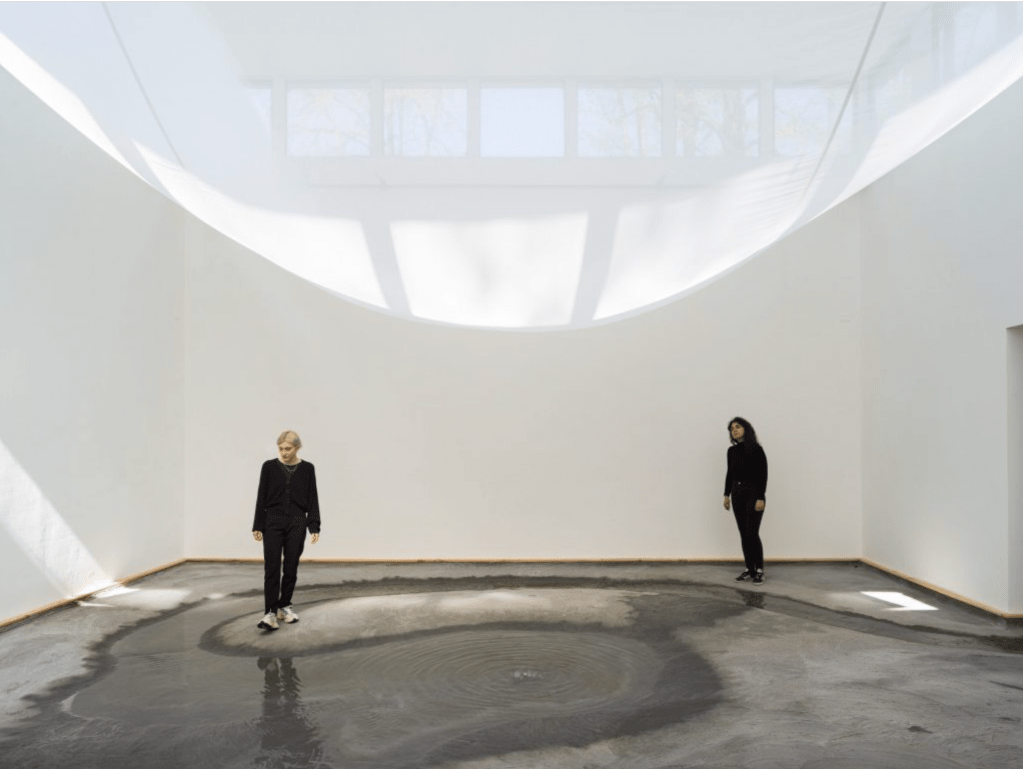
In the face of chaos and fragmentation, poetry remains. Here it is found mainly in the national pavilions, which provide the setting for several landmark projects. We may leave aside the German proposal, which is limited exclusively to QR codes, and go directly to the Danish pavilion Con-nect-ed-ness, featuring at its center a flowing stream of rainwater. It is a small oasis in this Biennale where uncertainty and anxiety reign. The water sprinkles aromatic herb plants, and the visitor is offered some infusions of them to be sipped and enjoyed – just what is needed to regain the strength to face the rest of the exhibitions. In short, this is an immediate sensory experience that silently makes the case for a holistic, ecological, and reassuring architecture.
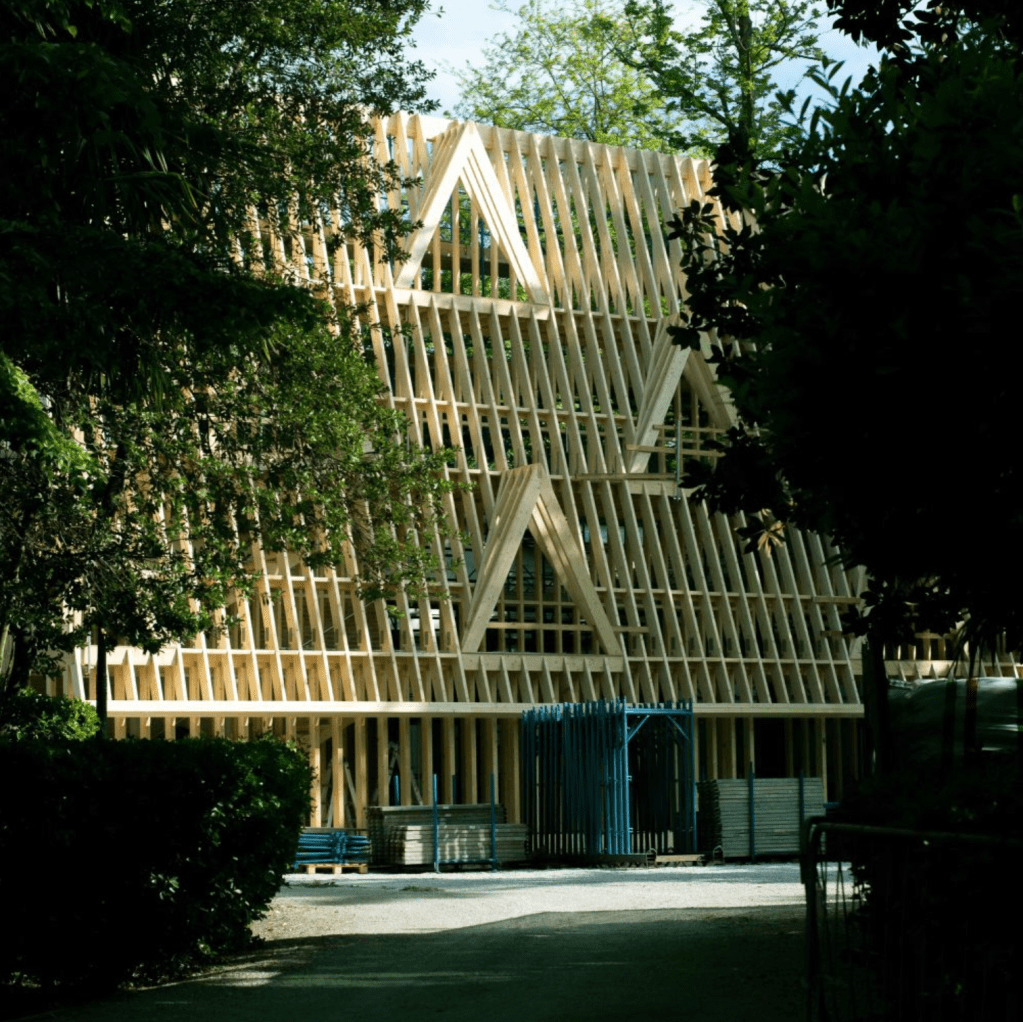
Close by is the US Pavilion, which works with a particularly American theme and explores ordinary architecture as a platform for new ideas, for a discourse that opens up new possibilities for design. The exhibition looks back at the history of wood framing and speculates on how buildings might be different if the system itself of wood framing were either radically restrained or radically exaggerated. Curators Paul Andersen and Paul Preissne practicing architects and educators, cladded the fancy stone pavilion in cheap pine. This striking structure is a demonstration of their conviction that swift, softwood construction is the true essence of American architecture. The U.S. Pavilion intensifies and alters a standard element or system as a means to remake the world in a surprising yet plausible way.
At the Swiss pavilion, the issue of borders is addressed in some very interesting interdisciplinary work centered around the testimonies of those who inhabit them and illustrating, among other things, how two people can have totally different points of view about the same space. In a nearby space, two young architects Mounir Ayoub and Vanessa Lacaille also examine the complex territory of the border space as the laboratory of the contemporary, allegorical epicenter of the current ruptures we are encountering. “In a world […] built more and more on identity regressions and the desire for compartmentalization, the border could paradoxically be a possible place to resist it,” we read in the booklet that accompanies the project.
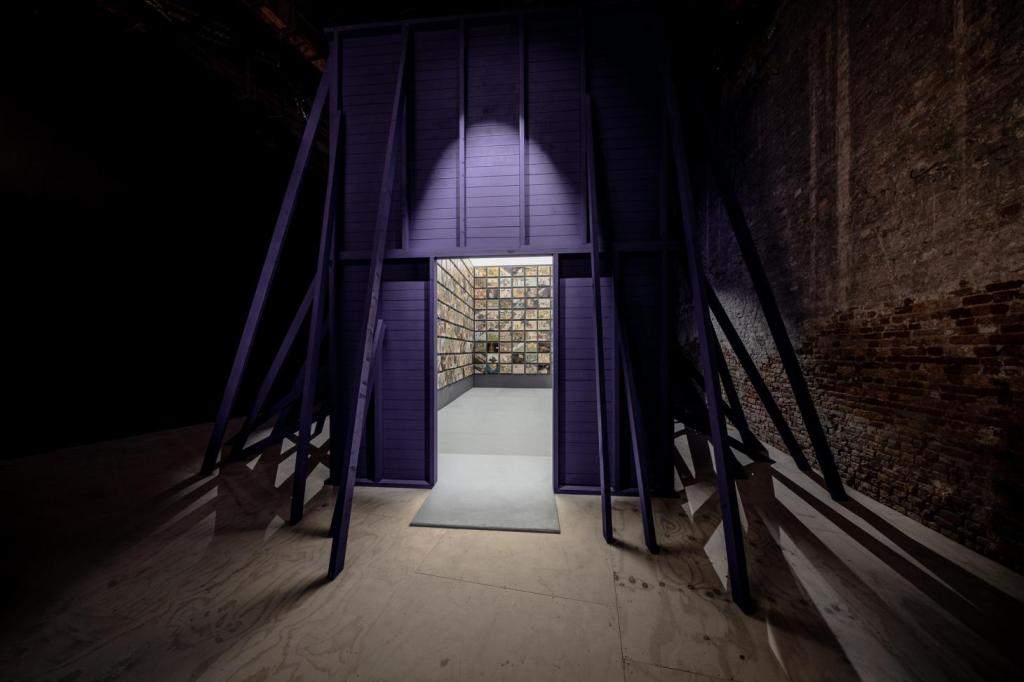
The collective production of knowledge, place for the imagination and for life-story telling are subjects addressed by the Chilean pavilion. For Testimonial Spaces, a team of historians and art students collected 500 anecdotes about life in an iconic social housing complex in Santiago: the José Maria Caro. There is a lost father who opens a door and goes to sleep in a bed other than his own, a child who wins a football match, a nap taken below the shade of a tree, men at the bar, evenings at the cinema, and arguments but also parties and bursts of laughter. All these life snippets are transposed onto a canvas, forming a gallery of 500 small colored pieces painted in primitive style that narrates, without naivety, the concept of “living together.” The memories of these Chilean families to some degree become those of the visitors, linking together with invisible threads complete strangers from different parts of the world. Without providing a concrete answer or even a fragmentary one to the question “How will we live together?” the emotions these images generate give us at least a clue.
In our worried and tormented world, this Biennale’s edition is, for the most part, too academic, confusing and at times tedious. Nevertheless, it does confirm one thing: We have been constantly been reminded during the pandemic of the brevity and fragility of life, and of the importance of living fully now, since there might not be ‘more’ or ‘forever.’ Moreover, we cannot live without genuine human encounters and poetry.
CAPTIONS
A/ Studio Other Spaces, “Future Assembly”
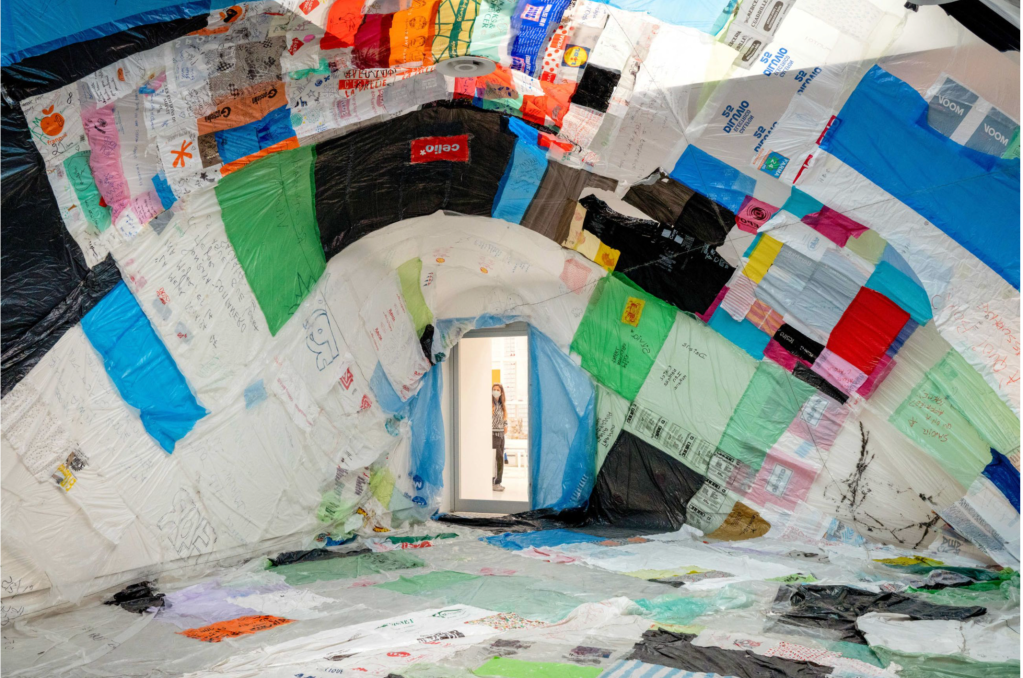
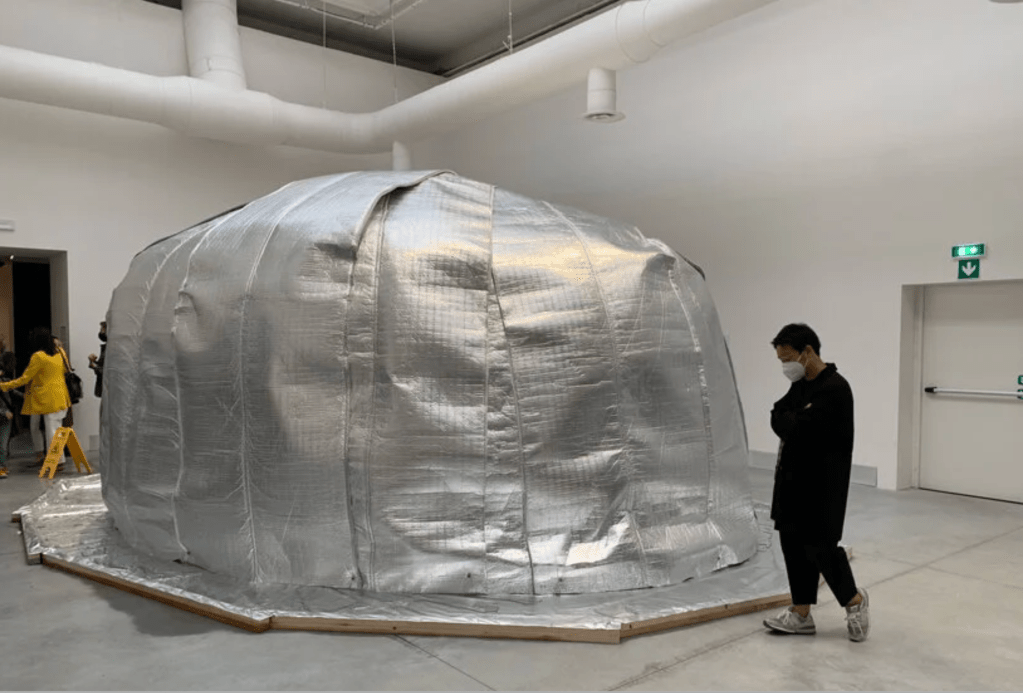
B/ One of the installations of the Museo Aero Solar by Aerocene Foundation in the Giardini’s Central Pavilion.
C/ Tomas Libertiny: “Beehive Architecture” at Slovakia’s Pavilion.
D/ Maison Fibre: Made of glass and carbon-fibre structures, University of Stuttgart.
E/ Rita Studio in Ivry-sur-Seine: Listen Up, Emergency Accommodation Center for Migrants and Romas
F/ Superflux: “Refuge for Resurgence”.
G/ Lina Ghotmeh: Living: an Archeology of the Future.
H/ Kei Kahoh Architects: Melting Landscape.
I/ the ‘Cloud Pavilion’: German Pavilion, a minimalistic empty space that exists in the digital realm through a series of barcodes on the walls.
J/ Lundgaard and Tranberg Architects, “Con-nect-ed-ness” at Danish Pavilion.
K/ Curators Paul Andersen and Paul Preissne. A frame-only wooden structure has been built in front of the U.S. Pavilion.
L/ Mounir Ayoub and Vanessa Lacaille : “Oræ – Experiences on the Border” at the Swiss Pavilion.
M/ Curators Emilio Marín and Rodrigo Sepúlveda. “Testimonial Spaces,” installation offered by Chile’s Ministry of Culture, Arts and Heritage, Chile.

