Nelida Nassar 05.05.2026
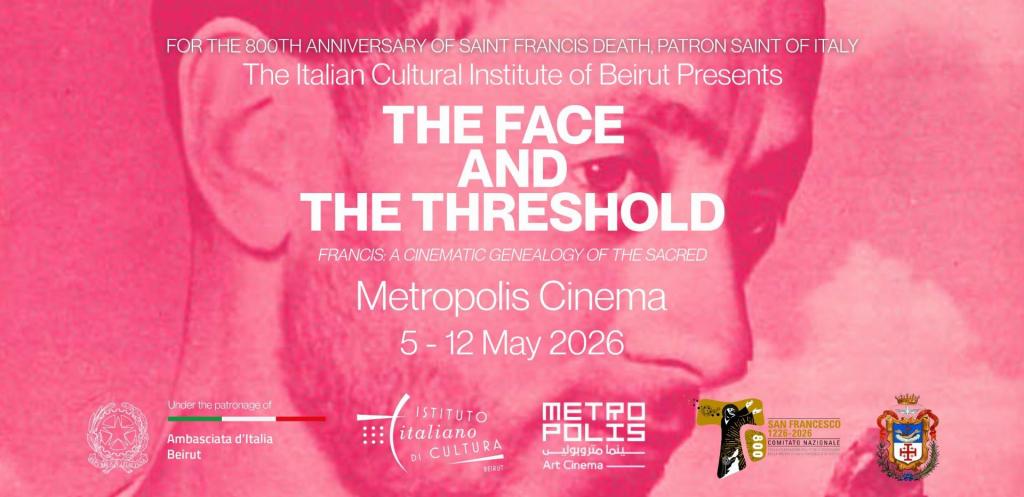
The celebration of the eight hundredth anniversary of the death of St Francis of Assisi is a significant moment for Italian culture worldwide. On this occasion the cultural director of the Italian Cultural Institute of Beirut Mr. Angelo Gioè brilliantly selected eight seminal films realized by the best Italian directors as well as two French ones that tackled St Francis life and accomplishments (see the list of the films below). The series selection was conceived to examine St Francis extraordinary historical and intellectual relevance from a poetic, philosophical and analytical perspective, much less from its commemorative aspect. In these films the image remains a form of knowledge, where reflection is never reduced to technical or purely conceptual language. Hence, St Francis appears to be one of the major turning points in medieval European civilization.
These eight seminal films have been thoroughly reviewed by several prominent cinema critics and historians as well as intellectuals thus I will refrain from repeating all their previous narratives. However, I will attempt to examine St Francis as a person of several dimensions that combined many disciplines of Spirituality and Faith, Spirituality and Activism; Spirituality and Ecology; Spirituality and Naturalism; Spirituality and Metaphysics.
Spirituality and Faith
Eight centuries after his passing, St Francis continues to inspire the world to go back to the essence of faith, toward humility and peace. In revisiting his life through cinema, this series becomes an invitation to rediscover a faith lived with sincerity and courage. St Francis reminds us that holiness is not distant or abstract, but found in simplicity, compassion, and empathy towards others. Historians, such as Jacques Le Goff, have shown how Franciscanism profoundly transformed the 13th-century imagination, introducing a new perception of poverty, a relationship to the material world, and the individual’s place in the community. More recently, thinkers like Ivan Illich and Giorgio Agamben have reinterpreted St Francis as a figure who shifts established structures, not through the conquest of power, but through a radical transformation of the very forms of life themselves.
Spirituality and Activism
What is striking about St Francis is that he does not correspond to the ascetic, somber, or punitive image that religious history has sometimes projected onto the figure of the saint. He is beset by contradictions, moments of fragility, and a kind of inner turmoil that makes him profoundly human. His revolution is not achieved through political action or violence nor a desire to destroy existing structures or politics. It stems from a different logic of living by example, of closeness to the excluded, of a rejection of hierarchies based solely on wealth, birth, or power. In an extraordinarily rigid medieval society, where each individual was assigned a function and a place, St Francis introduced an entirely new way of inhabiting the world.
Spirituality and Ecology
Long before the emergence of the contemporary ecological movement, some Franciscan insights reveal a striking modernity founded on a close relationship with beings, with life itself, and with everything that medieval society kept at a distance. His gesture toward the leper is undoubtedly its most powerful expression, in a world structured by the fear of contamination, by exclusion, and by a strict separation of bodies, St Francis chose contact, presence, and embrace. This shift profoundly altered the sensibilities of his time and continues to challenge our relationship to vulnerability, to the human community, and to the created world.
Spirituality and Power
This modernity is also expressed in his relationship to power. Francis never behaved like a revolutionary leader seeking to overthrow an institution. On the contrary, he understood that any lasting evolution requires a capacity for circulation, transmission, and connection. This is precisely what makes his journey so unique. He remained radical without becoming sectarian. Several historians have highlighted this fruitful paradox of a man who profoundly disrupted the symbolic order of his time while rejecting the logic of absolute rupture. Wasn’t he one of the first European religious reformers, who traveled to the Arab world to meet the Sultan of Egypt in 1219 in a gesture of unprecedented openness?
Spirituality and Metaphysics
It is also for this reason that Francis continues to resonate through the centuries. His figure constantly compels us to consider the passage between the visible and the invisible. His legacy is not limited to a spiritual tradition. It touches on questions that remain central to contemporary societies such as the overcoming of limits, the relationship to consumption, the possibility of a fraternity not based on identity or belonging, but on a shared human condition. For all these perspectives, Mr. Angelo Gioè’s thoughtful selection constructs a film cycle that shows not only the enduring nature of the Franciscan figure, but also the transformations in how it is perceived. While the different eras of modern cinema have each projected their own tensions, anxieties, and aspirations onto St Francis. His influence continues to resonate in contemporary consciousness far beyond the purely religious sphere, as a presence capable of reactivating essential questions about how we inhabit the world and relate to others. Beirut, the city at the intersection of civilizations, feels especially resonant to screen such a series. As St Francis was not only a figure of European religious reform, the Franciscan presence in the Holy Land and across the Mediterranean remains a tradition ever since.
Projected Films
• Roberto Rossellini: Francesco, giullare di Dio (The Flowers of St. Francis), 1950
• Enrico Guazzoni: Il poverello d’Assisi (The Poor Man of Assisi), 1911 accompanied by a Ciné-Concert performed Mario Rahi
• Ugo Falena and Mario Cors: Frate Sole (Brother Sun), 1918
• Pier Paolo Pasolini: Uccellacci e uccellini (The Hawks and the Sparrows), 1966
• Liliana Cavani: San Francesco d’Assisi, 1966
• Franco Zeffirelli: Fratello Sole, Sorella Luna (Brother Sun, Sister Moon), 1972
• Renaud Fely and Arnaud Louvet: Il sogno di Francesco (The Brotherhood: A Life with Saint Francis), 2016

