Nelida Nassar 03.01.2026

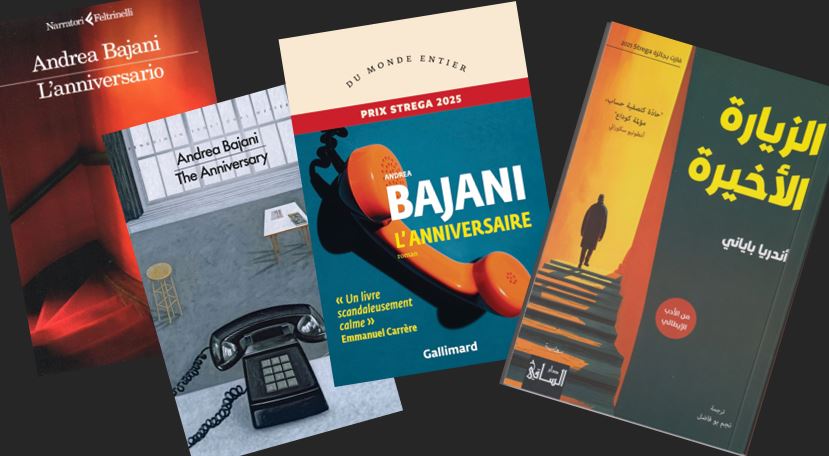
Beirut remains one of the most cosmopolitan and cross-cultural capitals of the world despite 50 years of war and regional conflicts. Upon my arrival here, a few weeks ago, I was invited by The Istituto Italiano di Cultura di Beirut to attend a presentation and discussion of Andrea Bajani’s novel The Anniversary, winner of the Strega Giovani Prize. The event was sponsored by the Maria and Goffredo Bellonci Foundation and Strega Alberti Benevento.
Charif Majdalani, a leading author of contemporary narrative fiction and finalist of the 2025 Prix Goncourt, introduced The Anniversary in French. The discussion was moderated by journalist Nanette Ziadé-Ritter. Also participating was Najm Abou Fadel, the book’s Arabic translator, and Angelo Gioè, Director of The Istituto Italiano di Cultura di Beirut. Following the event I had a telephone conversation with my friend Judith Gurewich of Cambridge, MA, USA. To my great surprise I learned that her company Other Press is the US publisher of both Andrea Bajani and Charif Majdalani. The two authors Bajani and Majdalani did not know each other previously; it seems they found each other by pure serendipity. This international connection across ocean and sea between the US, Italy and Lebanon confirms once more Beirut’s reputation as the intellectual hub of the Middle East.
The Anniversary (originally published in Italian by Feltrinelli) recounts a son’s choice to leave home and embark on a journey free from all obstacles and constraints. This is not, however, the classic adolescent tale of rebellion, nor a chain of arguments. A son who is very much aware of his emotions is self-portrayed through his efforts to overcome the oppressive burden of his childhood experiences. The novel implicitly asks: can one abandon one’s father and mother? Can one slam the door shut, walk down the stairs, and decide never to see them again? Can one ever escape their grip?
On the tenth anniversary of his leaving home, the author is finally ready to recount the wear and tear of the subtle but pervasive violence of life within the walls of his home. That he conveys the story of his unfortunate family without accusations or blame and with an astonishingly restrained voice lends it great, even brutal force. It is a heartbreaking anniversary.
The story is also a poignant and lucid portrait of a woman (his mother) who loses everything to gain the respect of her husband. She is kept locked up with their children in a routine where possession and the demand for love are interconnected and bargained for. The airtight isolation enforced by the father is occasionally breached by the ringing of a barely tolerated telephone, by the occasional schoolmate’s visit, or by a friend of the mother, who is soon banished. This microcosm of a concentration camp gradually creates an irrepressible desire for rebirth in the son, and in the readers — an urge to be themselves, to live their own lives, to open up to others without the fear of retaliation. To save themselves, they can save nothing from such a home.
The Anniversary is first and foremost a novel of liberation which unmasks and undermines the totalitarianism of the family. It wounds us with its honesty, disarms us with its candor, and lays us bare with its truth. It is the slap we received as soon as we were born: thanks to that pain, we breathe. “Ten years ago, that day, I saw my parents for the last time. Since then I’ve changed phone numbers, houses, continents, I’ve built an impregnable wall, I’ve put an ocean between us. They’ve been the best ten years of my life.” The Anniversary is a powerful novel – neither autobiographical nor auto-fictional – and an important work of contemporary Italian fiction that young adults, in particular, will find well worth grappling with.
The Anniversary (originally published in Italian by Feltrinelli) recounts a son’s choice to leave home and embark on a journey free from all obstacles and constraints. This is not, however, the classic adolescent tale of rebellion, nor a chain of arguments. A son who is very much aware of his emotions is self-portrayed through his efforts to overcome the oppressive burden of his childhood experiences. The novel implicitly asks: can one abandon one’s father and mother? Can one slam the door shut, walk down the stairs, and decide never to see them again? Can one ever escape their grip?
On the tenth anniversary of his leaving home, the author is finally ready to recount the wear and tear of the subtle but pervasive violence of life within the walls of his home. That he conveys the story of his unfortunate family without accusations or blame and with an astonishingly restrained voice lends it great, even brutal force. It is a heartbreaking anniversary.
The story is also a poignant and lucid portrait of a woman (his mother) who loses everything to gain the respect of her husband. She is kept locked up with their children in a routine where possession and the demand for love are interconnected and bargained for. The airtight isolation enforced by the father is occasionally breached by the ringing of a barely tolerated telephone, by the occasional schoolmate’s visit, or by a friend of the mother, who is soon banished. This microcosm of a concentration camp gradually creates an irrepressible desire for rebirth in the son, and in the readers — an urge to be themselves, to live their own lives, to open up to others without the fear of retaliation. To save themselves, they can save nothing from such a home.
The Anniversary is first and foremost a novel of liberation which unmasks and undermines the totalitarianism of the family. It wounds us with its honesty, disarms us with its candor, and lays us bare with its truth. It is the slap we received as soon as we were born: thanks to that pain, we breathe. “Ten years ago, that day, I saw my parents for the last time. Since then I’ve changed phone numbers, houses, continents, I’ve built an impregnable wall, I’ve put an ocean between us. They’ve been the best ten years of my life.” The Anniversary is a powerful novel – neither autobiographical nor auto-fictional – and an important work of contemporary Italian fiction that young adults, in particular, will find well worth grappling with.

