Nélida Nassar 10.20.2026
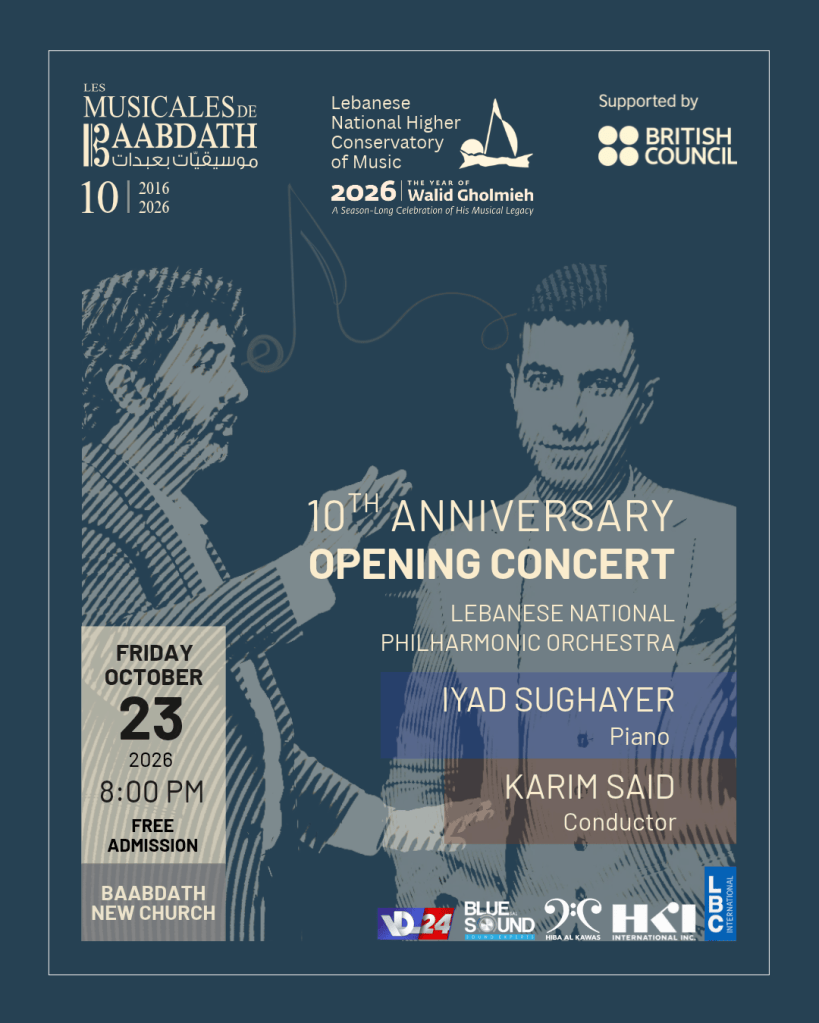
The delightful Les Musicales de Baabdath Festival 2026 celebrates its 10th anniversary this year with an opening concert presented in collaboration with the Lebanese National Higher Conservatory of Music, featuring the Lebanese National Philharmonic Orchestra. It will present its festival of 14 varied musical events spanning classical music, jazz and world music from October 23 to November 26, 2026. A unique feature of the festival is the availability of 500 free seats for the opening concert at the New Church of Baabdath. The event makes a bold start with the opening night featuring accomplished pianist Iyad Sughayer, with the orchestra conducted by acclaimed Karim Said, both born in Jordan. Dedicated to “Voices of the North,” the program also offers a vernacular glimpse through Ajnadayn, the first movement of Symphony No. 3, Al Yarmouk, by Lebanese composer Walid Gholmieh in remembrance of the fifteenth anniversary of his passing.
The pairing of Edvard Grieg’s Concerto for Piano & Orchestra in A minor and Jean Sibelius’s Symphony No. 5 in E-flat Major offers a highly satisfying balance across an evening. Both Grieg (Norway) and Sibelius (Finland) are their respective nations’ most celebrated cultural figures. Their music is famous for capturing the vast, rugged landscapes, freezing climates, and folklore of the Nordic region. Both pieces also reflect their composers’ national identities. Grieg heavily infuses his concerto with Norwegian folk dances and rhythms, while Sibelius channels Finnish nature (such as his famous “Swan Hymn” motif inspired by migrating swans in the Fifth Symphony). The late Gholmieh relies as well on folkloric motifs.
Grieg’s and Sibelius’s pieces also combine two towering nationalistic voices from the Nordic countries, representing the pinnacle of Nordic Late-Romanticism. The Grieg Piano Concerto serves as an explosive, virtuosic showpiece. It immediately grabs the audience with its legendary cascading piano entrance and offers high-energy Romantic drama. The three movements of the Piano Concerto enjoy the satisfying balance of Classical form, with a richness of melody that makes the work so attractive. In the slow movement, muted strings present the main theme with sumptuous harmony, while the soloist initially responds with elegant tracery and then with a full-blooded statement of the melody. The horn is prominently featured throughout this movement, which leads directly into the spirited finale, with its unmistakable echo of peasant boots and its taxing demands on the soloist’s technique. The flute introduces a melody of a quite different sort, which turns out at the end, after the return of the dance has been transformed into a lively three-four pattern, to be called upon to provide the closing bars in shamelessly grandiose style.
The Sibelius Fifth Symphony provides a profound, slow-building, and epic journey. It begins with the breadth and majesty of a vast, unfolding Nordic landscape. A mystical horn call rises and falls in an expansive arc, which opens the door to all that follows. Picked up by the woodwinds, the motif begins to fragment, spin, and develop with a sense of self-organizing inevitability. The Fifth Symphony evokes nature’s divine logic. On one level, it gives us a sense of motion through continuous development. On a deeper level, it enters into a mysterious, eternal stasis. In a way, this mirrors the cyclic nature of Finnish folk music. It is filled with rotating cells which end up where they began. This is music influenced by the bleak, remote landscapes of northern latitudes, where perceptions of time may be altered by seasonal cycles which involve extended periods of darkness alternating with light. The Fifth also has an outgoing personality, with a dramatic first movement and a heroic finale. It strikes a tone of soaring optimism. It shifts the emotional weight of the evening toward a grand, architectural conclusion, capped by six iconic final orchestral chords of late Romanticism. The core shared identity of the performed pieces promises an opening evening of stunning virtuosity, poignant lyricism and a powerful, melodically rich perspective on the Romantic symphonic tradition.
For more information, go to the website: https://lesmusicales.org/oct-23-2026/

