Un-veiling Carlo Massoud “Maya, Zeina, Racha, Yara: Wooden Dolls” Installation.
All posts by Nélida Nassar
Beirut Spring Festival: An Intimate Debutant, Creative and Innovative Festival
Piero Mascetti Paintings: A New Pictorial Language
Watadour: A Visual Experience of “Liquid Modernity”
Black Out: Exquisite Dance Meets Performance Art
A New Museum Like No Other May Be Changing Everything in Beirut
Kholoud Nasser Dazzling Performance of Dario Fo’s “A Woman Alone”
Zahi Haddad Insightful and Captivating Autobiography “Au Bonheur de Yaya”
Watadour: A Visual Experience of “Liquid Modernity”
Nelida Nassar March 30, 2014
Watadour is a performance attempting to decipher physically and virtually the complex world we live in. It merges different taxonomic categorizations of various art forms: dance, music, theater and drawing. The question of what is dance, what is music, what is theater or drawing? What are their different boundaries is what Watadour tries to answer throughout a mélange and hybridization of these disciplines. This is the sign of our
times defined by Zygmunt Bauman as “liquid modernity.”
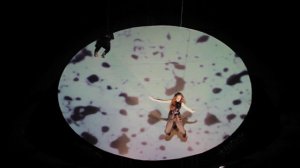
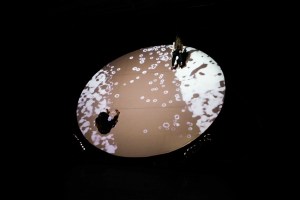
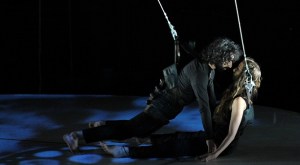
The reality created on stage is everything but reassuring. Two dancers with their bodies strapped like mountain climbers perform on a circular stage that is gradually moving
from a horizontal to a vertical position. The two dancers struggle adapting their body movement and position while attempting to reach the summit or deal with their daily challenges to find themselves propelled down without ever giving up, over and
over again. A circular stage has no direction, no top or bottom except for the node
that of reality, disturbed, repositioned, shifted like a mirror, like a rotating clock or
mother earth.
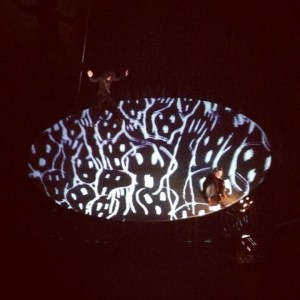
Using a man-made art box that is attached to an electronic device, Mazen Kerbage moves with dexterity drips of black ink creating and projecting imagery reminiscent of the Surrealist’s écriture automatique, Jackson Pollock’s drip painting or yet the Ebru of the Ottomans’ marble paper making. The images are reflected and refracted on the circular stage merging, pulsing and punctuating the dance with brio. They enhance it and overpower it at times while being enthralling. Kerbage’s marks are the most beguiling and innovative part of the performance.
The accompanying music performed by Sherif Sehnaoui is an eclectic mix of custom tailored sound with new compositions and electro acoustic scores, a captivating pas de deux of improvised language in response to Kerbage’s gesture.
Is the dancer/the human being irretrievably condemned to the same movement or fate?
Or can he ever breaks from his shackles thus freeing himself? A compelling visual experience with a nihilist feeling permeates the entire piece that alas seems at times a tad too dislocated.
Concept/Choreography: Omar Rajeh
Original Idea / Scenography: Nasser Soumi
Dance/Creation: Mia Habis, Bassam Bou Diab
Composition/Live Music: Sharif Sehnaoui
Visual Creation (Live Setting): Mazen Kerbaj
Costumes: Mia Habis
Light Design: Jonathan Samuels
Production: Zaher Kais, Christel Salem
Set Construction: Abou Ajram Group Ajran
Produced by: Maqamat Dance Theatre
Funded by: The Norwegian Embassy in Beirut
Supported by: British Council
With the Support of: Abou Ajram Group S.A.R.L., Omar Qassem Al Issa’i Group
Venice, La Serenissima Inspires Matteo El-Khodr and Mario Rai
Nelida Nassar 02.08.2014
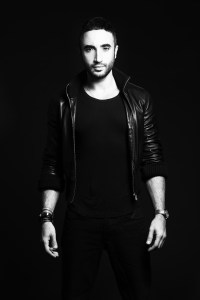
Recognized as a singer of exceptional artistry and versatility, Matteo El-Khodr is a captivating and inspiring young talent who is already generating excitement in the professional musical world and does not need an introduction to the Lebanese public.
His warm counter alto voice brings polished musicality to oratorio, opera, and music.
An accomplished interpreter of the music of Vivaldi, El-Khodr will sing tomorrow evening at the Assembly Hall of the American University of Beirut where he is regularly a soloist.
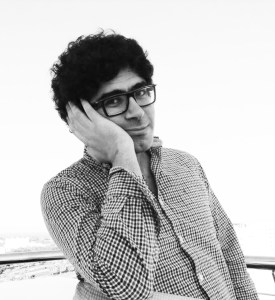
The conductor is the rising star none other than the violinist Mario Rai, another
Lebanese talent.
The selected repertoire celebrates Venice, her wide geographical span due to trade relations with both the East and the West was continuously influenced by musical styles that originated in many parts of Europe, North Africa, and the Middle East. Although it historically bred a great many musicians of rare skill, the Republic frequently searched for talented performers and composers through diplomatic networks. It is no coincidence that Venitian music appealed equally to both El-Khodr and Rai. Re-appropriating its musical influence, the pair inverted Venice’s historical role by preparing a concert dedicated to bringing la Serenissima to the Orient thus our shores with a rich program of:
George Frideric Handel: Serse: FrondiTenere / Ombra mai fu
George Frideric Handel: Giulio Cesare / Al lampo dell’armi
Geminiano Giacomelli: Merope / Sposa non mi conosci
Arcangelo Corelli: Concerto Grosso N.8 (fatto per la notte di natale)
George Frideric Handel: Rinaldo / Venti Turbini
Antonio Vivaldi: Farnacce / Gelido in ogni vena
Alessandro Scarlatti: Il Pompeo / O cessate di piagarmi
Riccardo Broschi: Artaserse / Son qual nave agitate
Both artists focuses also on presenting famous and less known composers’ works that were the first to include dynamics and instrumentation style and technique for both voice and instrument repertoire. What other surprises the tuneful, graceful music may bring? It is certain that the bright Rai and the theatrical and gifted El Khodr will certainly not disappoint with their stylistic interpretation?
El-Khodr will continue with a European tour that include
Saint Moritz: February 17, 2014
Zurich: February 19, 2014
La Salle Pleyel: February 25, 2014
Paris la Cite de la Musique: March 18, 2014 where he will recreate the role of Hyacinthus in Mozart’s first opera Apollon and Hyacinthe

